
Book Title: The White Deer
Series: n/a
Author Name: Regina McBride
Publication Date: September 22nd, 2026
Publisher: Green City Books
Pages: 319
Genre: Historical Fiction / Russian Historical Fiction
Any Triggers: n/a
Twitter Handle: @cathiedunn @AuthorMichael57
Instagram Handles: @reginamcbride @thecoffeepotbookclub
Hashtags: #HistoricalFiction #RussianHistoricalFiction #Chekhov #BlogTour #TheCoffeePotBookClub
Tour Schedule Page: https://thecoffeepotbookclub.blogspot.com/2026/09/blog-tour-the-white-deer-by-regina-mcbride.html
Book Title and Author Name:
The White Deer
Regina McBride
Blurb:
In the summer of 1879, on his way to Moscow to study medicine, 19-year-old Anton Chekhov, from a bankrupt merchant class family, stops to spend a restful few weeks in the Ukrainian countryside, staying with his friend, Dr. Mitrofan, who is worried about Anton’s lingering bronchitis. It is here that Anton meets Vera Denisova, also 19, a budding actress, the daughter of theater aristocrats from Volkhov, a neighboring estate. The two spend much of their time wandering Volkhov’s vast property, hoping for a glimpse of a white deer that has been spotted in the back acreage.
As they grow closer, Vera confides in Anton about her secret romance and heartbreak over Petya, a servant her age who was gifted at drawing and who she helped to acquire an apprenticeship as a draughtsman in order to leave servitude for good. Anton is fascinated by her obsession, and a triangle forms between Vera, Anton, and the absent Petya. Anton, too, shares his secrets with her, his conflicted relationship with his indigent family and his frustrated wish to publish stories. Surreptitiously through Anton, Vera learns the truth about her family’s declining financial situation and the impending loss of her beloved childhood estate. Together in the long, extended light of summer days, Vera and Anton struggle to come to terms with their feelings for each other and the new profoundly changed world that is waiting for each of them at summer’s end.
The final section of the novel charts the correspondence between Vera and Anton over the next two decades. Vera has become a successful actress and Anton, a doctor who treats peasants for free, has more than realized his ambition as a writer.
In a final letter to Vera before his death at 44 of tuberculosis, Anton reveals that his play, The Cherry Orchard, was inspired by his time with her at Volkhov.
Praise for The White Deer:
“In this stirring tale, McBride evokes a sense of place with lush depictions of birch stands and daisy fields along with a soundtrack of Tchaikovsky and folk tunes, creating a backdrop for Vera’s tender and chaste friendship with Anton. It’s an evocative portrait of a vanishing way of life.“
~ Publishers Weekly
“This transportive novel sweeps the reader up into a vivid, melancholic dream set on a nineteenth century Russian estate. Regina McBride creates her own Chekhovian tragi-comedy that delights as it captures a lost world frozen in time. The White Deer is a gripping must-read for anyone who loves literature and a love story gone awry.“
~ Virginia Pye, author of Marriage and Other Monuments
Excerpt 1:
When we were still children and it was raining, Petya and I stayed in the kitchen. Aniuta would clear spots for us at a rough wood table, place a lamp between us, and we would draw pictures.
It was apparent right away that Petya had a talent for drawing. I would often put my pencil down and watch him, awestruck, as he drew. Sometimes I lay my head on my arms on the table, watched the movements of his pencil and listened to its soft breathing as it grazed the dry paper. From that angle I could see the circle of concentration around him. It reminded me of a halo on an icon. Slowly, whatever he was envisioning began to appear on the blank sheet of paper, becoming more and more dimensional.
Even when we were small Petya had a strange, source-less maturity. Of course I couldn’t articulate that back then. He knew himself in some way that I didn’t know myself. His drawings somehow showed that, too. They were textured with so much dimension. He could see whatever he was drawing in his own memory; he needed no models.
He defied everything I’d been taught about servants. How could a lesser being, as I was always being told servants were, draw and focus the way he did? How could someone less human than me observe the world with such intensity?
When we were seven or eight, he told me a story about a tiny girl who married a grasshopper. One day the girl was seen making her way through tall blades of grass, her face streaming with tears. She climbed on the back of a blackbird who flew away with her. Petya did not know why the girl had escaped. He had fallen asleep when his aunt was telling the story. She had left Volkhov the next day so we never found out what happened. The two of us tried to imagine why the tiny girl ran away.
I had watched, mesmerized, as with an astonishing precision, Petya drew a large grasshopper. When it was finished he held it up for me to look at. I recoiled at the eyes, two bald globes covered all over with minute, barely visible squares, a smeared dot in the center of each eye.
He looked at his own drawing in horror, as if it had come from somewhere else and not through him. Always reticent, he asked me, “Why would she have married him?”
I could still hear the sound of his quiet, low-pitched voice as he asked the question.
It was terrifying how alive the grasshopper was, so alive it was threatening. Petya and I looked at one another and a chill seized my back and shoulders. I was afraid the enormous insect would hop off the page, so I asked him to put the drawing outside in the grass. We both knew that day, watching from the kitchen door as the rain blurred the image and darkened the paper, that Petya had a gift. It was not my gift. It was his, but he included me in it somehow. In some way, we shared it, or he shared it with me. Maybe because he was afraid, as I was afraid, and it was better that there were two of us.
Aniuta kept icons in a small dark alcove room near the stove, the faces of saints quivering and shifting in candlelight. Since the first time we came into the kitchen together, Petya expressed awe of the little room. He stood at the doorway staring in. That day after he’d drawn the grasshopper and put it out in the rain, he went in that little room for the first time and I followed. The room was so small I had to stand behind him. Being very near him in the trembling candlelight I’d felt breathless. I was so close I could smell him, a soft defused scent of hay or dried grass and something else, which I decided was the wind, which his clean muslin shirt had likely hung out in to dry. I breathed Petya in, filled with elation. I thought I might float upwards.
After we stepped out of the room, Petya drew Theotokis, the holy mother with her sacred little boy. He didn’t draw her in the stiff manner of the old icon itself, but lovely and soft in her veil and garments, she and her little boy of human proportions. And Petya’s Theotokis had compassionate eyes, not the cold vacant ones you saw in the stiff figure of the usual icon. After that day he drew Theotokis repeatedly. And I used to think his Theotokis looked like his own mother, a quiet woman who worked as a seamstress, embroidering dinner napkins or the collars of shirts. His saints all had the faces of real people from his life. They were not stiff unfeeling figures. Not flat and without dimension. Sometimes he drew St. Nicholas of Winter, who, in his eyes, looked like our servant, Nickander, who’d been a teenager when we were children, a very large man even in his adolescence, with a wide, kind face. Sometimes he drew St. Ambrose with his gray double-pointed beard, always with the face of his father, Fyodor. But mostly, besides drawing horses and a certain linden tree, he drew Theotokis with his mother’s face.
Buy Link:
Universal Buy Link: https://books2read.com/u/mvaor8
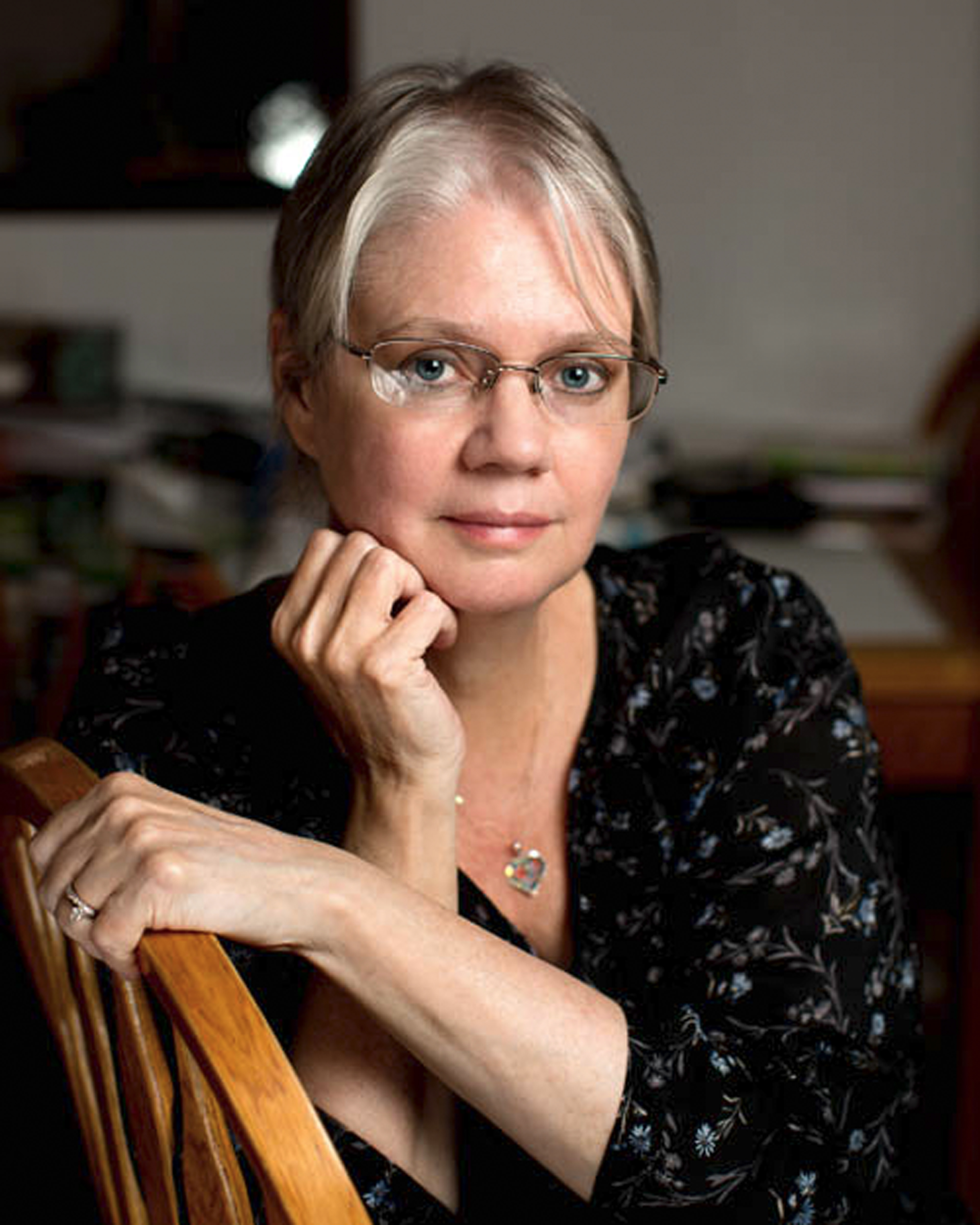
Author Bio:
Regina McBride is the author of eight books. The White Deer ~ a novel of Anton Chekhov is her sixth novel. She is also the author of one memoir, Ghost Songs, and one book of poetry.
Her novel, The Nature of Water and Air, was a Booksense Pick (Independent Book Stores Selection), a Barnes and Noble Discover Great New Writers book, and a Borders Original Voices choice. It was optioned for a film. Her books have been translated into five languages.
A recipient of fellowships from the NEA and the New York Foundation for the Arts, Regina lives in New York City, where she taught fiction writing for thirty years at Hunter College and continues to teach privately.
Author Links:
Website: https://www.reginamcbride.com/
Facebook: https://www.facebook.com/profile.php?id=100010471921681
Instagram: https://www.instagram.com/reginamcbride/
Amazon Author Page: https://www.amazon.com/stores/Regina-McBride/author/B001IXMGLE Goodreads: https://www.goodreads.com/author/show/71686.Regina_McBride

