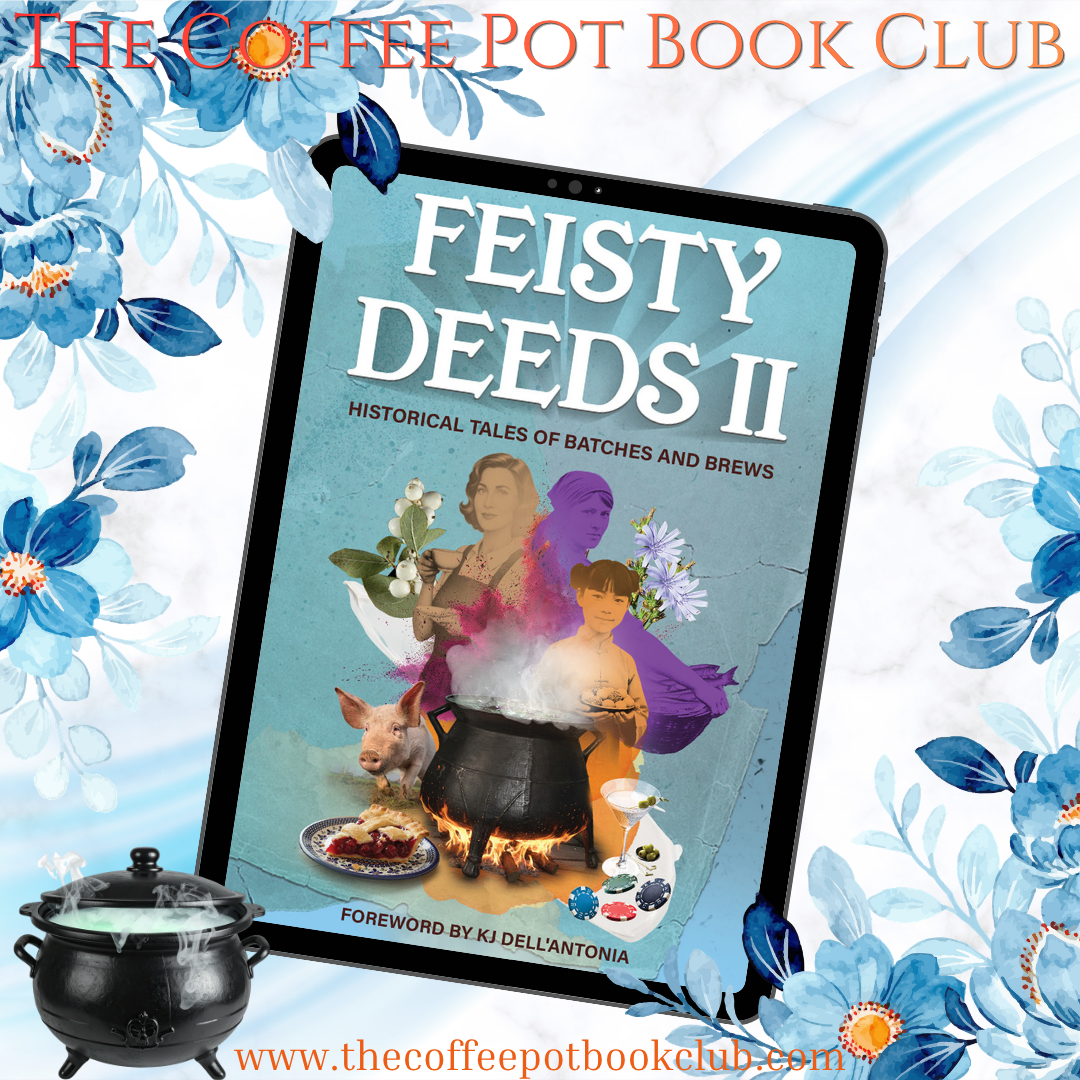
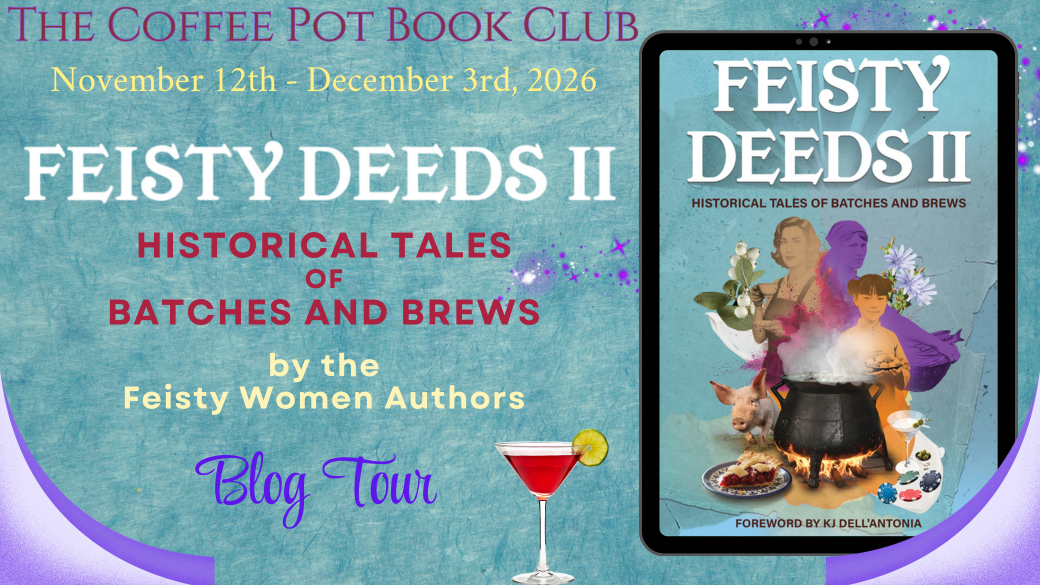
Book Title: Feisty Deeds II: Historical Tales of Batches and Brews
Series: Feisty Deeds (https://www.amazon.com/dp/B0G4STPQZJ
This is the second Feisty Deeds anthology from Women’s Fiction Writers Association authors who are members of the WFWA Historical Fiction Affinity Group.
Participating Authors’ Names (in alphabetical order):
Apple An, Debra Borchert, Paulette Brooks, Teri M. Brown, Elisabeth Carson-Williams, Gabi Coatsworth, Joan Fernandez, Beth Anne Hill, Carolyn Korsmeyer, Beata Kurcz, Heather Dodge Martin, N. J. Mastro, Christy Matheson, Kimberly Nixon, Lorraine Norwood, Margaret Porter, Barbara Buckley Ristine, Suzanne Uttaro Samuels, Elaine Aucoin Schroller, Kay Smith-Blum, Kimberly Sullivan, Ashley E. Sweeney, Nina Wachsman, Patty W. Warren, April Quarto Wright
Editors (in alphabetical order): Carolyn Korsmeyer, Christy Matheson, Elaine Aucoin Schroller, Kay Smith-Blum, and Kimberly Sullivan
Publication Date: December 12th, 2025
Publisher: n/a
Pages: 286
Genre: Historical Fiction, Novellas & Short Stories, Women’s Fiction
Any Triggers: n/a
Twitter Handle: @cathiedunn
Instagram Handles: @feisty.women.authors @thecoffeepotbookclub
Hashtags: #FeistyDeedsIIHistoricalTalesofBatchesandBrews #WomensHistoricalFiction #Anthologies #ShortStories #WomensFiction #WFWA #WomensFictionWritersAssociation #BlogTour #TheCoffeePotBookClub
Tour Schedule Page: https://thecoffeepotbookclub.blogspot.com/2026/10/blog-tour-Feisty-Deeds-II-anthology.html
Book Title and Author Name:
Book Title: Feisty Deeds II: Historical Tales of Batches and Brews
By the Feisty Women Writers
Author Names:
Apple An, Debra Borchert, Paulette Brooks, Teri M. Brown, Elisabeth Carson-Williams, Gabi Coatsworth, Joan Fernandez, Beth Anne Hill, Carolyn Korsmeyer, Beata Kurcz, Heather Dodge Martin, N. J. Mastro, Christy Matheson, Kimberly Nixon, Lorraine Norwood, Margaret Porter, Barbara Buckley Ristine, Suzanne Uttaro Samuels, Elaine Aucoin Schroller, Kay Smith-Blum, Kimberly Sullivan, Ashley E. Sweeney, Nina Wachsman, Patty W. Warren, April Quarto Wright
Blurb:
Meals, treats, brews, and potions from another batch of feisty characters.
Whether cooking for solace, scrounging for food, concocting medicine, or brewing poisons, the feisty women in these stories will keep you thirsting for more. Twenty-five tales will transport you far afield in time and place: third century Ireland, medieval Europe, twentieth-century Australia. Read your way from a hippie commune to a WW II internment camp in the Philippines; from a Renaissance palace to a Polish village wracked by war, the hills of Appalachia, and a sleepy Ontario town.
Mixtures to soothe, heal, and thrall are prepared in these pages, where lovers take revenge, mothers protect their children, and feisty women make choices in a challenging world.
Edited by Carolyn Korsmeyer, Christy Matheson, Elaine Aucoin Schroller, Kay Smith-Blum, and Kimberly Sullivan
Foreword by K.J. Dell’Antonia, New York Times best-selling author of the novels The Chicken Sisters, Playing the Witch Card, In Her Boots, and the non-fiction book How to Be a Happier Parent.
All proceeds earned from this collection are destined for the WFWA Scholarship Fund, which benefits authors with financial constraints, allowing them access to conferences, writing craft classes, and technology that will enhance their writing careers.
Excerpt from “The Manx Charmer”
Feisty Deeds II: Historical Tales of Batches and Brews
by Margaret Porter
Maughold Parish, Isle of Man, 1777
The May Eve flames died out before sunrise, and the morning breeze funneled the lingering scent of smoke through Cornaa Glen. At the island’s eastern edge, Calybrid Teare found fresher air and an ample supply of Patrick’s Cabbage. According to the Book of the Teares, Ireland’s saint used one of its broad pointed leaves to seal a cut on his finger. When fisherman Will Callow came to her—not her father—she’d spread a glaze of plantain balm over the gash on his forearm.
That, she reflected as she plucked greenery, wasn’t all he sought from me.
For months she’d endured the uncertainty and vulnerability of her secret love. Now, in her nineteenth spring, she was discovering the bliss of reciprocal affection.
She added the gleanings to the feathery fern fronds and velvety moss and ruffled lungwort foliage she’d gathered in the glen. Hoisting her rope creel to her shoulder, she walked toward the placid bay, bracketed by a pair of low hills, both summits scarred black by last night’s bonfires. Native loaghtan sheep and spring lambs grazed the heather and gorse covering the slopes. Lower down, hares chased each other through the bracken. Although winter white still mottled their furred bodies, the advancing season had browned their heads and ears.
Shallow waves lapped the pebbled beach, where several women and their offspring searched for limpets in pools left by the outgoing tide. On this first day of turf-cutting, their husbands would be busy with faayl spades and baskets, carving out peat blocks to fuel kitchen fires.
Hearing the plod of hooves on the path, Calybrid angled her head to see who approached. She went to meet the rider, the leather soles of her carranes crunching the stony shingle.
“God prosper you, Finlo Standish.”
“I spied you passing through Cornaa village and guessed you’d be foraging your way from the village to the shore.” A gust lifted strands of rusty hair from his broad shoulders. “When last I saw Will Callow, he asked me to serve as his dooinney moyllee. I agreed, of course, to praise him to you as a worthy suitor. An honest, upright fellow. And a strong hauler of nets.”
The warm sensation within her bodice expanded upwards to her face and along her limbs. “I’m acquainted with his fine qualities.”
“You’ll wed him, then?”
Calybrid smiled. “I’ll answer that question when Will puts it to me himself.”
“I don’t doubt he soon shall, for I’ve seldom seen a man so enraptured. Your sorcery is all pretense, but there’s no denying the effect of your beauty.”
A compliment embedded in an insult. Her voice hardened as she declared, “Yes, I’m a ben-obbee. A charmer. But I also prepare potions and cures for crofters and their livestock, and perform blessings. Like Father does, and my grandmother did. Never have I acted for a foul purpose. Or recited a harmful curse.”
But if ever she wished to learn the dark spells, she could. The methods of punishing adversaries with doom and destruction filled the back pages of the Book of the Teares, a compendium of medical lore and incantations recorded and preserved by her ancestors. Countless generations had passed the leatherbound volume from man to woman, woman to man. The designated charmers of the family, duty bound to keep it safely hidden away, were the only persons permitted to read it. Calybrid might rightfully study the ways and means of maiming, ruining, or even killing, but she couldn’t imagine ever wishing to.
A friendly gesture, she hoped, would prove her benevolence and refute his false impression that she was a sorceress. She reached into her creel for a miniature cross of rowan twigs tied together with a strand of brown loaghtan wool. Approaching him, she held it high so he might take it. “No witch, genuine or false, would offer you a crosh cuirn.”
“I want none of your useless tokens.” He bent low in the saddle. “Respectable housewives spin yarn and weave linen and sell their butter and cheese to support their husbands and children. You take in copper and silver coins by convincing gullible and superstitious folk that your mixtures and your mutterings have magical properties. Fortunate for you that so many credulous fools populate this island.”
His disdain was as forceful as a gale, dispersing the goodwill she owed her sweetheart’s ally. She resented his criticism of the farmers and villagers and fishermen who relied on her and her parent for assistance or relief. Knowing he’d scoff and sneer, she wouldn’t boast of the successes that proved their skills. Bold as a weasel, this man, fond of an argument.
“Tell me, is Master Teare at home? I must obtain his agreement to the match, and discover what your bride’s portion will be.”
Maintaining a semblance of civility, she informed him that her father had been summoned to Castle Cashin to ease a servant’s stomachache. She didn’t invite him to the cottage to await Father’s return. That would require her to endure his company far longer than she was willing.
Buy Links:
Universal Buy Link: https://buy.bookfunnel.com/hv51sg2w3u
Available Editions
eBook ISBN: 979-8-9912002-5-7
Price $3.99 (USD)
Paperback ISBN: 979-8-9912002-6-4
Price $11.99 (USD)
Author Bios: See separate file, with authors’ website links.
Reviews (optional):
Midwest Book Review of Feisty Deeds II
Feisty Deeds II: Historical Tales of Batches and Brews is the second book in the Feisty Deeds anthology to celebrate women. This story delves into the potions, brews, medicines and foods women concocted in the course of supporting families, their lives, and their objectives.
Lest readers think these tales will comprise some sort of cooking memoir, be advised that what’s being cooked up are connections to life, death, and survival. These shatter the notion that women of the past were less thinking, proactive, or empowered than those in modern times.
Take “Snowberry Season” by Ashley E. Sweeney, for example. Flora McTavish’s 1800s Oregon life is vivid as she struggles with loving another woman in an era where such love is not only forbidden, but unknown. How this connects with Scotland, faeries, forbidden unions, and clever plots makes for an engrossing tale of discovery, determination, and action that draws with personal revelation and cements with a sense of revenge and betrayal.
“Love Happily Ever After” by Patty W. Warren is set in North Carolina in 1969, offering a more contemporary view of women’s lives and mettle. Here, modern witches with love potions and Ada’s determination to help her fellow woman coalesce in a warm description of fabulous meals, wellsprings of happiness, and a lasting legacy one woman concocts out of her own life successes.
N.J. Mastro’s “Breadline” is set in 1939 Minnesota and captures the unwritten rules of being women during those times as the first-person narrator offers her younger protégée words of wisdom for survival: “The first lesson is this: bread is like money during hard times like these.” It turns out that bread is more than a food as the story builds an evocative structure that reflects on survival tactics, politics, and hunger.
Each story crafts a different place, time, and circumstances of feisty women interacting on levels that both drive and support their strengths as they make choices that impact their worlds. Each offers a sense of enchantment as these revelations transmit to readers different sensory perceptions of women who employ their powers and abilities in new directions. These embrace culinary and herbal wisdom in building the kinds of connections that make a difference in their worlds.
Librarians and readers seeking stories that are heartwarming, tender and purposeful, and evocative will find Feisty Deeds II: Historical Tales of Batches and Brews provides diverse lessons in history and experience that are cemented by women’s experiences and approaches to life.
Touching in its personal lives, powerful in its diversity and scope, and satisfyingly thought-provoking for book clubs and reader group discussion, Feisty Deeds II: Historical Tales of Batches and Brews both supports the prior Feisty Deeds short story collection and stands alone as a compelling exploration of women’s experiences and perceptions as they reach for new inner strengths and transmit them into the world around them.”
—D. Donovan, Sr. Reviewer, Midwest Book Review
Self-Publishing Review of Feisty Deeds II
“Another empowered collection of tall tales centered on history’s unsung heroines, Feisty Deeds II: Historical Tales of Batches and Brews is a stirring testament to righteous rule-breaking and radically independent minds. From grief in ancient Ireland and wartime dreaming in the Philippines to maternal hopes in Australia and well-deserved vengeance in Virginia, these globe-spanning tales of dauntless women are pitch-perfect, timely, and meticulously crafted. As K.J. Dell’Antonia sagely notes in the foreword, “women live closer to the line between life and death,” and while these stories range in subject matter and seriousness, each one incisively captures the burden, beauty, and unwavering resilience of women in any era.”
The Prairies Book Review of Feisty Deeds II
A sweeping, intimate, and beautifully told celebration of women’s resilience.
Feisty Deeds II: Historical Tales of Batches and Brews presents twenty-five stories that illuminate how women across eras have stirred, brewed, mixed, and mended their way through history. Framed by a thoughtful foreword from K.J. Dell’Antonia, the collection begins with the premise that women’s daily labor—whether in gardens, kitchens, or makeshift infirmaries—has long shaped lives in ways both subtle and essential.
Across lands and centuries—Ireland to Europe, Renaissance courts to wartime Pacific islands, Appalachia to Ontario—the stories return to mixtures that sustain or undo. Scarce meals, secret herbs, handed-down cures, and poisons brewed in silence form the book’s heartbeat. With each act, women protect, resist, sacrifice, or seize control. The anthology moves between tenderness, darkness, and the mythic, yet each story centers a woman acting with purpose despite her era’s constraints. Wartime mothers endure, Renaissance cooks navigate peril, and modern women face inherited wounds—each leaving a mark. Though varied in style, the stories hum with the same quiet resonance. From era to era, these women shape their worlds through what they mix, prepare, and choose.
Fans of historical fiction and thoughtful portraits of resilience will feel right at home in these pages.
Author Bios, Feisty Deeds II: Historical Tales of Batches and Brews
Apple An, “Rice Balls,” Beijing, China, 1973
Apple An is a Chinese-American award-winning author, professor, and cultural memoirist writing under her pen name. She began her literary journey in 2017, aiming to preserve cultural memory and foster empathy through stories rooted in real life. Her literary work blends deep research with intimate reflection, offering a bridge between past and present. The piece in this anthology was a spin-off from her second historical novel, Daughter of Blue City: A Novel of Coming-of-Age Through Revolutionary China.
Apple is the mother and guardian of five children who became successful adults. She lives in Baldwinsville, New York. A lifelong learner and creative soul, she enjoys tennis, ballroom dancing, gardening, travel, and the arts. Her mission is to preserve cultural memory, foster human connection, and tell stories that linger long after the last page. Learn more at www.AppleAnBooks.com.
Debra Borchert, “As a Dove’s Wing,” Castres, France, 1517
Debra Borchert is the award-winning author of the Château de Verzat series of historical novels (Her Own Legacy, Her Own Revolution, Her Own War). At her characters’ insistence, she published their recipes in the companion cookbook, Soups of Château de Verzat: A Literary Cookbook and Culinary Tribute to the French Revolution. His Last Christmas Gif is her first romance novel. Her writing has appeared in The New York Times, San Francisco Chronicle, The Christian Science Monitor, and The Writer, among others. While on a research trip to Toulouse, France, she learned about the ancient art of woad dyeing. The extensive process produced a beautiful blue color known as the “Blue of Kings,” hence the name today, royal blue, and inspired “As a Dove’s Wing.” www.DebraBorchert.com.
Paulette Brooks, “Two Cups of Tea,” Port Credit, Ontario, 1967
Her short story, set near Toronto in the 1960s, features a runaway dog, a secret garden, and a real-life mystery. Deeply moved by the stories of a Japanese Canadian neighbor who was detained in an internment camp during WWII, Paulette imagined a cultural exchange over tea, designed to soothe two wounded hearts.
Learn more about Paulette and her writing at www.pbrooksauthor.com.
Teri M. Brown, “A Bit of Mountain Magic,” Burnsville, North Carolina, 1932
Teri M Brown has published four novels: Sunflowers Beneath the Snow, a historical fiction set in Ukraine, An Enemy Like Me, a WWII family saga, Daughters of Green Mountain Gap, a generational story about Appalachian healers, and Peg, Unhinged, a humorous look at menopause. She’s excited her Feisty Deeds II short story, “A Bit of Mountain Magic,” continues Josie Mae’s journey as a healer. Her short story, “The Youngest Lighthouse Keeper” is included in Feisty Deeds: Historical Fictions of Daring Women. Teri’s inspirational memoir, 10 Little Rules for a Double-Butted Adventure, details life lessons she learned while riding across the US on a tandem bicycle. She wrote a children’s picture book, Little Lola and Her Big Dream, at the request of her granddaughter. In addition to writing award-winning books, Teri is host of Online for Authors and the Book Hook, podcasts showcasing Indie and small press authors. Follow Teri at www.terimbrown.com.
Elisabeth Carson-Williams, “Just Desserts,” Franklin County, Virginia, 1934
Inspired by her students and fueled by curiosity, native Virginian Elisabeth “Lis” Carson-Williams is always on the hunt for stories of ordinary people who lived through extraordinary times. She writes stories that capture the themes and voices of those not found in a textbook. Her novel, Castaway on the Isle of Devils, is an adventure tale based on the true fate of the Sea Venture, the shipwreck that inspired William Shakepeare’s The Tempest, as experienced by the women who were there. Her latest short story, “Just Desserts”, follows a female moonshiner in Franklin County, VA. as she dispenses her special brand of liquid justice. Every month, Lis shares stories of the untold, forgotten women of history. To read Lis’ monthly feature, Women & Girls, or to sign up for her newsletter, visit: www.ecarsonwilliams.com.
Gabi Coatsworth, “Trouble Brewing,” Wales, 1935
Award-winning writer Gabi Coatsworth was born in Britain and says she writes with a British accent, even when her books take place in Connecticut, where she lives. She has published two novels, both featuring a benign ghost: A Beginner’s Guide to Starting Over (2023) and A Field Guide to Library Ghosts (2025).
The idea for her short story came from a newspaper article about a wife who poisoned her husband, but she has no idea why she set the tale in Wales, except that it’s a land of mystery. Perhaps it was Gabi’s memory of doing a little foraging there years ago. She says she was lucky not to poison anyone herself!
To learn more or to sign up for special bonus materials, start here: https://linktr.ee/gabicoatsworth
Joan Fernandez, “The Herring Girl,” Shetland Islands, Scotland, 1906
In her short story, “The Herring Girl,” Joan Fernandez explores the claustrophobic tension of a ticking clock, trapping her characters in a jail where they are forced into quick confidences and a clever escape. Fernandez is drawn to stories of young women who confront old assumptions and have the courage to choose love over heartbreak, changing the course of their own lives and the lives of others. This theme also drove her debut novel, the award-winning Saving Vincent, A Novel of Jo van Gogh, which recounts the true story of how a young woman’s devotion helped Van Gogh rise to iconic status. A retired senior marketing executive, Joan now spins tales from St. Louis and Sedona, breaking from authorly duties for imaginative antics with her grandkids. www.joanfernandezauthor.com.
Beth Anne Hill, “A Whispered Miracle” Appalachian Foothills, Alabama, 1866
Beth Anne Hill is a writer and educator born and raised in the Appalachian Foothills of Alabama. Her first publication, “Tracing the Spirit,” can be found in the first Feisty Deeds anthology. Beth Anne’s family stories have featured in the Appalachian Bluebird news column and on the Tennessee Valley’s longtime radio show, The Sundial Writers Corner. When she’s not writing or teaching children, Beth Anne enjoys antiquing, reading, and exploring the countryside. She shares her home with her two-peas-in-a-pod husband and Goddaughter and playful fur-babies. www.bethannewriter.com.
Carolyn Korsmeyer, “Remedy,” Occitania, France, 1244
After a career teaching and writing philosophy, Carolyn Korsmeyer turned her hand to fiction. She is especially drawn to historical fiction and ways that novels can help us understand beliefs that prevailed in the past. She has published three novels, and a fourth, No Final Harbor, will be released in 2027. For details about her work, see www.carolynkorsmeyer.com.
Beata Kurcz, “The Lublin Cebularz,” Lublin, Poland, 1944
Beata has always been drawn to historical fiction that features quiet acts of courage, especially in times of upheaval. She draws inspiration from her family’s archives: military draft slips, land deeds, and an identification card her grandfather brought home from a labor camp. Her research often uncovers colorful, heroic women and men hidden in historical footnotes. She digs through those footnotes to bring their stories to light.
Her short story “The Lublin Cebularz” explores wartime separation through the lens of the women left behind: wives, daughters, and mothers waiting for their men to return.
Beata lives with her partner and two children in a quiet town outside Warsaw, Poland, where she spends her days writing, reading, and hiking in the nearby forests. Follow her journey at www.beatakurcz.com.
Heather Dodge Martin, “Chicory is Not Coffee,” Northern California, 1970
Heather Dodge Martin weaves stories of women making a place for themselves in the complex world of the 1970’s. She believes that the political, cultural, and economical upheavals of that decade still echo today. The back-to-the-land movement setting of “Chicory is Not Coffee” also inspired her short story “The Harvest in the Seed,” published in Beginnings and Endings: The San Joaquin Valley Writers 2025 Anthology, as well as her novel-series-in-progress. Heather’s writing blends her passion for nature with re-imagined snippets of family history and a desire for a better world.
When she’s not visiting museums to indulge a deeply nerdy passion for history and archaeology, she enjoys outdoorsy, hippie-ish pursuits. Heather lives in rural Northern California with her human family, plus three chickens and their two feline overlords.
You can find her by name on social media or on her website www.HeatherDodgeMartin.com.
N.J. Mastro, “Breadline,” St Paul, Minnesota, 1935
N.J. (Nancy) Mastro writes historical fiction. After a four-decade career in education, in 2025, she published her debut, Solitary Walker: A Novel of Mary Wollstonecraft. “Breadline” was inspired by her maternal grandmother, Mabel, to whom she was especially close. Grandma Mabel really did work at a Swedish boardinghouse in Waukegan in the 1930s, but the rest of the characters are fictional. Rounding out the tale is Minnesota and St. Paul history during the Great Depression. Nancy also publishes a blog called Herstory Revisited, where she combines facts with biographical fiction that shines a spotlight on women from the past. Besides writing, she reads extensively, loves Italian and French wines, and is an avid cook. Her specialty: baking bread, which she learned, of course, from Grandma Mabel.
Find out more about Nancy’s novel, blog, and her other writing projects at www.njmastro.com.
Christy Matheson, “Escape to the Peaceful Valley,” Ireland, 3rd Century
Characters you connect with. Adventure. Love. Family… and endings that are more than a sugar rush.
When Christy Matheson is not throwing ordinary characters into fairy tales, she is busy raising five children. (Very busy.) She writes character-driven historical fiction with and without fantasy elements, and her “fresh, smart, and totally charming” stories have won multiple awards.
Christy is also an embroidery artist, classically trained pianist, and sews all of her own clothes. She lives in Oregon, on a country property that fondly reminds her of a Regency estate (except with a swing set instead of faux Greek ruins), with her husband, five children, three Shelties, one bunny, and an improbable quantity of art supplies.
Please join Christy in conversation about books and determined women throughout history.
Join her newsletter to get free stories, art giveaways, & puppy pictures. https://sendfox.com/ChristyMatheson. And you can always find her at: https://christymatheson.com.
Kimberly Nixon, “Promises and Pie Crusts,” Northwest Ohio, 1929
Kimberly Nixon writes family stories featuring strong, determined—and sometimes delightfully wild—characters. Drawing inspiration from real people, she shapes and embellishes their personalities into unforgettable protagonists. She is the author of Rock Bottom, Tennessee and Rock Bottom Rising novels based on the true story of her grandmother’s felony conviction in 1925 Appalachia. Her latest release Cutie Pies by the Slice explores found family and the environment in a small 1930s Midwestern town. An International Firebird Book Award winner and Bookshelf Awards finalist, Kimberly divides her time between Austin, Texas, and Crested Butte, Colorado, and commits to living a story worth telling. Learn more about her literary journey at www.kimberlynixon.com.
Lorraine Norwood, “Feast and Famine,” Warwickshire, England, 1320
Lorraine Norwood is living proof that you can take the girl out of the mountains but not the mountains out of the girl. After many years away, she has returned to the Blue Ridge Mountains of Western North Carolina where she is working on The Margaret Chronicles, an historical fiction series set in14th century England, Germany, and France. The Solitary Sparrow, the first book in the series, was published in 2024. While doing research, she was fascinated to learn of the climate changes that occurred early in the century causing thousands of peasants to die of starvation. Luckily, Meg, her main character survived. Learn more about Lorraine and her writing at www.lorrainenorwood.com.
Margaret Porter, “The Manx Charmer,” Isle of Man, 1777
Margaret Porter is the award-winning and USAToday bestselling author of fifteen historical novels in multiple subgenres and two contemporary romances. After studying British history in the U.K., she trained as an actress, performing on stage and screen, and earned an M.A. in Radio-Television-Film. Her Manx ancestry inspired memorable journeys to the Isle of Man, a favorite setting for her stories. Members of the Teare family, the most renowned of Manx “fairy doctors,” dispensed folk medicines and charms until well into the 20th century, passing secrets from male to female, and female to male. Their fictional descendent Calybrid—and others in “The Manx Charmer”—appear in The Islanders Series, a trilogy set twenty years later, published in multiple editions and languages. Margaret has been recognized by Who’s Who in Authors, Editors and Poets and Who’s Who in Entertainment. www.margaretporter.com.
Barbara Buckley Ristine, “The Tearoom,” Virginia City, Nevada, 1880
Barbara Buckley Ristine is a former trial attorney who has returned to her first love, writing. Her short fiction has appeared in many fine literary journals and anthologies. Her debut novel, The Face Painter, set during the First World War, will be published in late 2027.
“The Tearoom” draws from the rich history of Nevada, where Barbara lives, and from current events concerning women’s reproductive rights. Virginia City boomed as a mining town in the late 1800s, becoming the largest industrial city between Denver and San Francisco for a time. Anthony Comstock, the anti-vice crusader, never visited Nevada, but he instigated national legislation banning contraceptives, abortifacients, and “obscene” materials. The Comstock Act is still on the books in the U.S.
You can follow Barb’s Substack, Postcards from the Past, at https://barbristine.substack.com/ and learn more about her work at www.BarbaraRistine.com.
Suzanne Uttaro Samuels, “The Sweetest Burden,” Girgenti, Sicily, 1859
Suzanne Uttaro Samuels is an award-winning legal scholar turned novelist whose writing explores resilience, hidden histories, and women’s voices across time. Her debut novel, Seeds of the Pomegranate (Sibylline Press, 2025), follows a young Sicilian artist entangled in a counterfeiting scheme in New York. Her fiction and essays appear in Petigru Review, Snapdragon, and the anthologies Main, Feisty Deeds: Historical Fictions of Daring Women, and Desert of Dreams. She has taught writing workshops from Denali National Park to the Adirondack Center for Writing. Her contribution to Feisty Deeds II: Batches and Brews draws on her fascination with marzipan, a confection central to Sicilian culture. This motif carries forward into her forthcoming novel, The Orphans’ Wheel, where marzipan becomes a symbol of memory, survival, and transformation amid Sicily’s nineteenth-century political and social upheavals. www.suzannesamuels.com.
Elaine Aucoin Schroller, “Sandwiches and Shortbread,” Sydney, Australia, 1922
Elaine Aucoin Schroller is a former technical writer who writes about love, loss, secrets, and redemption during challenging historical times. She became enthralled by stories of Americans and Australians working and fighting together in WWI France and WWII Australia and has published two award-winning novels, Dare Not Tell and The Bravest Soldiers, and is finishing The Last Post, her third novel in the series. Her short stories, “Ripples in a Pond” in Feisty Deeds: Historical Fictions of Daring Women and “Sandwiches and Shortbread” in Feisty Deeds II: Historical Tales of Batches and Brews, are companion pieces to her novels. When she isn’t writing the next chapter or dreaming up travel plans for fun and research, Elaine wrangles the rescue cocker spaniels that she and her husband have welcomed into their home and hearts. Learn more about Elaine’s work at www.elaineschroller.com.
Kay Smith-Blum, “Intersection,” Dallas, Texas, 1951
A sunrise writer, Kay Smith-Blum pens tales from a bayside perch in Seattle. Her multi-award-winning debut novel, Tangles, a Cold War story of love, loss, and hope is centered on the dangerous aftermath of the Hanford Nuclear Reservation. “Intersection” is a companion tale to one of three works in progress. She works out her writer’s block in the nearest lap pool and her three sons’ gardens. Smith-Blum’s Pushcart and Best of the Net nominated short pieces may be found in many fine literary journals and on her website: www.KaySmith-Blum.com. Follow her writing journey on Facebook at Author Kay Smith-Blum, on Instagram @discerningKSB and on TikTok @KSBwritesfiction.
Kimberly Sullivan, “The Girl from Sermoneta,” Italy, 1507
Kimberly Sullivan is a New Yorker in Rome. She writes contemporary and historical women’s fiction and is the award-winning author of six novels and one short story collection. Back in elementary school, Kimberly was assigned a research project on Cesare and Lucrezia Borgia. She still has no idea what the teacher was thinking – but she was hooked. Since then, she’s been a devoted groupie of Pope Alessandro VI and his brethren. In Rome, she lives close to Cesare and Lucrezia’s mother’s home, and often climbs the “Borgia staircase”. She’s attended lectures on the mysteries of the deadly Borgia wine of her story, read Machiavelli’s ode to Cesare, visited castles where Lucrezia resided and lands Cesare conquered. In Ferrara, she admired the lock of Lucrezia’s (painted) hair and tasted Lucrezia’s wedding cake, topped with spaghetti to replicate her golden hair. Kimberly will be forever grateful for the age-inappropriate research! kimberlysullivanauthor.com
Ashley E. Sweeney, “Snowberry Season,” Oregon Territory, 1814
A native New Yorker, Ashley E. Sweeney is the 2017 Nancy Pearl Book Award winner for her debut novel, Eliza Waite (2016). Since then, she has published three additional novels: Answer Creek: A Novel of the Donner Party (2020), Hardland (2022), and, most recently, The Irish Girl (2024). Her short stories have appeared in three anthologies and her works have won more than 20 literary awards. Sweeney lives in the Pacific Northwest and Tucson and enjoys gardening, art quilting, reading, traveling, and mosaic art. www.ashleysweeneyauthor.com.
Nina Wachsman, What Happened in Vegas,” Las Vegas, Nevada, 1948
Nina Wachsman writes stories with strong female protagonists, and has been a featured speaker on “Writing Kick-A Female Protagonists” at international writers’ conventions. Her female painter-assassin in Feisty Deeds I and the female PI in this anthology, though from different eras, demonstrate the same boldness and savviness in facing their challenges and enemies. An elite courtesan of Venice who must rescue her pirate lover in Nina’s latest historical mystery, The Courtesan’s Pirate, set in 17th Century Venice and the Caribbean, is a 2025 Anthony nominee for Best Historical. Website: www.ninawachsmanauthor.com.
Patty W. Warren, “Love Happily Ever After,” Raleigh, North Carolina, 1969
Patty W. Warren is also the author of “Junebug,” a story of a young woman yearning to be a Women Airforce Service Pilot during World War II, in the award-winning anthology, Feisty Deeds: Historical Fictions of Daring Women. She writes stories of everyday women, who make decisions in the face of doubt and conflict, changing their lives. Patty grew up in the South, where her family seeded her imagination with storytelling and the importance of those who went before her. Patty is a member of the Women’s Fiction Writers Association, where she does a weekly newsletter for the Historical Fiction Affinity Zoom Group. She is also a member of the N.C. Writer’s Network and the Historical Novel Society. She is currently finishing a novel highlighting the strength of a mother’s love. She lives on the southern coast of North Carolina where she enjoys the beach, golfing, reading, and writing. More information about Patty can be found at www.pattywwarren.com.
April Quarto Wright, “Detritus Cake,” Manilla, Philippines, 1945
“Detritus Cake” was inspired by the food ingenuity and resilience of the internees at Santo Tomas Internment Camp in the Philippines during World War II. Over three thousand internees, primarily American and British civilians, were interned by Japanese armed forces in Santo Tomas University from January 1942 to February 1945. They were liberated by the U.S. military with the aid of Filipino guerillas on February 3, 1945.
As a professional artist, hula dancer, and certified book coach, April Quarto Wright is inspired by all facets of storytelling. Her historical novel set in 1930s Hawai’i was a finalist for the 2025 WFWA Rising Star Award, and she continues to write stories based on her Filipino/Okinawan heritage and experiences as a military spouse living overseas. Most of her writing time is spent in an ice rink as a hockey mom of three boys, and she will bring her cherished cookbook collection wherever the military sends her family next. You can find more about her book coaching, writing, and art at www.aprilwrightcreative.com.