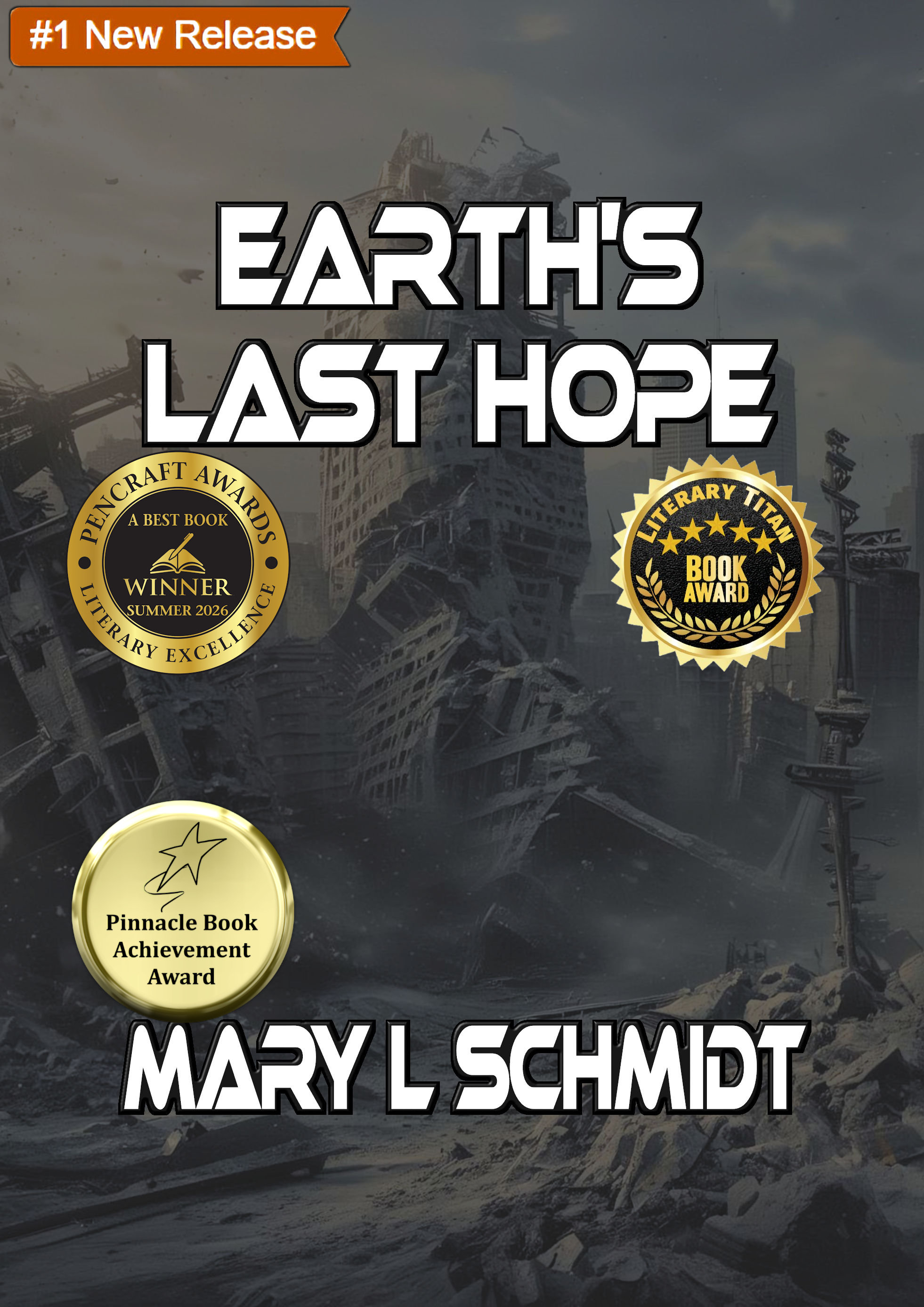
***** Earth’s Last Hope vs Andy Weir’s The Martian *****
#EditorialReview #AndyWeir #TheMartian
“The book reminded me somewhat of Andy Weir’s The Martian. Both stories enjoy explaining solutions instead of simply announcing that a problem has been solved. Weir tends to build those solutions through tightly constrained engineering and scientific problem-solving, while Schmidt blends scientific explanation with speculative technology, government coordination, faith, and family life. Her canvas is also much larger. Instead of one person trying to stay alive, she follows an entire society trying to figure out what living should look like after almost losing the planet.”
From Amazon:
What if you live in Denver metro, and in one day, you must find or make a bunker, filled with non-perishable food, water, and cold weather clothing to last for ten years, and manage to prevent volcanic ash particles getting into the air you breathe, when Yellowstone’s caldera erupts with eruption lasting more than a year, and it starts erupting during an atmospheric river of snow and four day blizzard of up to twenty feet of snow, thrusting you into a volcanic winter of up to ten or more years, leaving behind an un-inhabitable, barren, and desolate Earth?
What would you do?
What if you thought you had two or more years of warning before the caldera of Yellowstone would erupt as a super volcano, and suddenly you are told you have one day at best to survive?
Dr. Theodore Grey decided that the scientists under him had their measurements wrong or there was a glitch in the system. Yes, Yellowstone was rumbling, but it did that every day, and the scientists at the USGS Yellowstone Volcano Observatory (YVO), led by Scientist-in-Charge Dr. Theodore Grey, utilized a sophisticated network of GPS sensors and seismometers to monitor the heartbeat of this active super volcano. All the movement in and around the caldera that is Yellowstone National Park is monitored and measured every day, 24/7, with computerized resources. Many scientists and technical people are necessary to monitor the computers, all the equipment, and cover Yellowstone’s large expanse of crater and park land. Yellowstone has thousands of small quakes each year. The subtle Chicago-sized area of ground deformation near Gibbon Falls had buckled upward by one inch in January 2026, but these new numbers must be wrong! Even the newly discovered magma cap 3.8 km deep in January rose sharply overnight! Seven inches of rapid, sustained uplift? No way. That was too phenomenal for the caldera. Seven inches meant high-pressure fluid movement and is indicative of a significant magma intrusion. Real-time information stared back at him from the monitors. Real-time quakes were more pronounced in and around Yellowstone, and some areas close to Yellowstone certainly felt this shift and change. Dr. Rick Long confirmed what Dr. Grey saw in front of him. SEVEN inches in ONE day!! The ground was tilting and rising by inches, not centimeters! The Earth’s crust was reaching its breaking point! The energy built up was too much, too fast. Dr. Grey knew he had to update the President right away. Time was critical. Everything was critical. So much for having a ten to twelve year plus warning! That powerful atmospheric river and a “monster blizzard” projected to drop up to twenty feet of snow over much of the US, including Yellowstone, would not stop the eruption!
Can Earth be saved? If so, who or what will save Earth?
Editorial Reviews
Review
In Earth’s Last Hope by Mary L. Schmidt, an overnight volcanic threat throws the whole country into chaos, forcing the government to trigger top-secret emergency protocols. General James Tilson has to completely ditch his quiet retirement and put his uniform back on to run a crucial underground sanctuary operation. With a deadly storm moving in fast, Tilson helps rush local doctors, teachers, and kids down into a massive, 36-floor secret bunker hidden right under the Denver Federal Center. Outside the steel gates, the air turns into a toxic nightmare of heavy snow and glass ash that suffocates life on the surface. The whole situation gets turned on its head when military leadership reveals that human survival is actually tied to crashed UFO tech hidden away since 1947.
“Earth’s Last Hope by Mary L. Schmidt is a really fascinating sci-fi disaster book that takes a total left turn halfway through the plot. It starts off feeling like a traditional prepper story, but quickly escalates into a deep-state military thriller. I appreciated the grounded, everyday tone the author uses to show what life would actually be like inside an underground bunker. I especially loved the focus on training the teens to take over complex operations because it adds a smart, long-term layer to the survival strategy, showing that the community is actively planning for the future instead of just waiting around. The casual, easy-flowing dialogue makes it feel like you are overhearing genuine families navigating a global disaster. By blending the harsh truths of an environmental collapse with uplifting, relatable moments, the book actually transforms into an unexpectedly touching story of survival. It’s an engaging read that avoids a ton of tech jargon while keeping the stakes high. I recommend it to fans of military sci-fi, intense environmental doomsday stories, or anyone who loves a good government conspiracy twist.”
In Earth’s Last Hope by Mary L. Schmidt, an apocalyptic event looms ahead. Scientific monitoring reveals that there are only hours left before the caldera blows. Dr. Theodore Grey, the head scientist with the USGS and the USA, is appalled at the magnitude of what is about to happen as the danger grows imminent with every passing hour. Dr. Grey alerts the President of the impending catastrophe, and General James Tilson decides to evacuate with his family and extended family, including doctors Sarah and Aaron and their children. Now they are in an underground bunker, a world of darkness beneath the Denver Federal Center. As the volcanic ash and a blizzard plunge the world into darkness, survivors are achingly aware that they might be headed for a ten-year volcanic winter. But there is a twist that makes the story even more suspenseful.
In Mary L Schmidt’s Earth’s Last Hope, after seismic activity beneath Yellowstone begins accelerating beyond every existing scientific prediction, President Joyce Zimmerman orders General James Tilson to relocate his family into a classified bunker system beneath Colorado while millions of Americans attempt to escape the approaching eruption. Inside the underground shelters, doctors, engineers, military officials, scientists, children, and surviving families attempt to build a functioning society as communication with the surface grows increasingly uncertain. Dr. Theodore Grey continues searching for a method capable of stopping the caldera before Earth enters a volcanic winter expected to last for years. However, each failed attempt pushes humanity closer toward permanent collapse. As Tilson oversees security operations connected to hidden facilities beneath Denver, classified information tied to the Roswell incident begins to reshape everything the government understands about survival, technology, and the planet’s future.
Literary Titan
Mary L. Schmidt’s Earth’s Last Hope is an apocalyptic survival novel that starts with a frighteningly simple problem: Yellowstone is about to erupt, and humanity has almost no time to prepare. When scientists realize the supervolcano is behaving far more aggressively than expected, President Joyce Zimmerman and government leaders move quickly to protect as many people as possible. Much of the story follows retired General James Tilson and his extended family as they take shelter in a massive underground complex beneath the Denver Federal Center. Schmidt spends a lot of time showing how bunker life actually functions, from hydroponic food production and medical care to schooling, security, recreation, and daily chores. That practical detail gives the novel the feel of both a disaster story and a survival manual, while the worsening eruption, ash-filled atmosphere, extreme cold, and collapse of normal society keep reminding everyone that the world above them is changing permanently.
What gives the book its personality, though, is its focus on family and community. James may be dealing with presidents, generals, secret facilities, riots, evacuations, and classified missions, but he’s also Grandpa James, a husband and the emotional center of a sprawling family. The quieter scenes matter just as much as the disaster scenes. People cook together, work in the hydroponic gardens, teach children, fall in love, get married, play games, paint, pray, deal with injuries, and eventually welcome new babies. Those moments create an unusual rhythm for an apocalypse novel because Schmidt is interested in more than simply surviving the next catastrophe. She’s interested in what people would do with ordinary life once ordinary life has been forced underground. Faith is also central to that vision. Prayer, gratitude, marriage, childbirth, and the belief that humanity has a future become recurring parts of the characters’ response to enormous loss.
About halfway through, Earth’s Last Hope expands from disaster fiction into science fiction when the Nyard, an advanced extraterrestrial race secretly connected to humanity since the Roswell era, become crucial to Earth’s survival. Their technology changes the scale of the novel dramatically. Instead of concentrating only on how long people can endure underground, the story begins asking whether the planet itself can be repaired. Yellowstone is permanently neutralized, new technology removes volcanic ash from the atmosphere, nanobots assist with cleanup, and a new source of clean energy helps humanity rebuild. In that sense, the book reminded me somewhat of Andy Weir’s The Martian. Both stories enjoy explaining solutions instead of simply announcing that a problem has been solved. Weir tends to build those solutions through tightly constrained engineering and scientific problem-solving, while Schmidt blends scientific explanation with speculative technology, government coordination, faith, and family life. Her canvas is also much larger. Instead of one person trying to stay alive, she follows an entire society trying to figure out what living should look like after almost losing the planet.
The result is a hopeful kind of apocalypse story. There’s tremendous destruction here, including mass death, ruined cities, toxic ash, starvation, psychological trauma, and the near extinction of humanity, but the novel keeps returning to rebuilding. By the final chapters, survivors are confronting what remains of Denver, salvaging materials, restoring communities, welcoming new life, and imagining a society built differently from the one that disappeared. The birth of Georgy near the end works especially well as a symbol of that direction, arriving just as the characters finally face the physical remains of their former homes. The epilogue carries that idea forward three years into reconstruction, with salvaged stone, granite, new infrastructure, and green energy becoming the foundations of another civilization. Earth’s Last Hope is ultimately a story about catastrophe as a test of cooperation. Its biggest interest is the question of what people preserve when nearly everything familiar is taken away, and its answer is remarkably consistent: family, knowledge, faith, useful work, community, and the determination to build something that can last.
Awards:
Reader’s Favorite 5 Star Read – 2026
Pencraft Winner Best Book Science Fiction Summer 2026
Pinnacle Gold Winner Summer Environmental 2026
Literary Titan – Gold Winner Fall 2026

