Media Kit
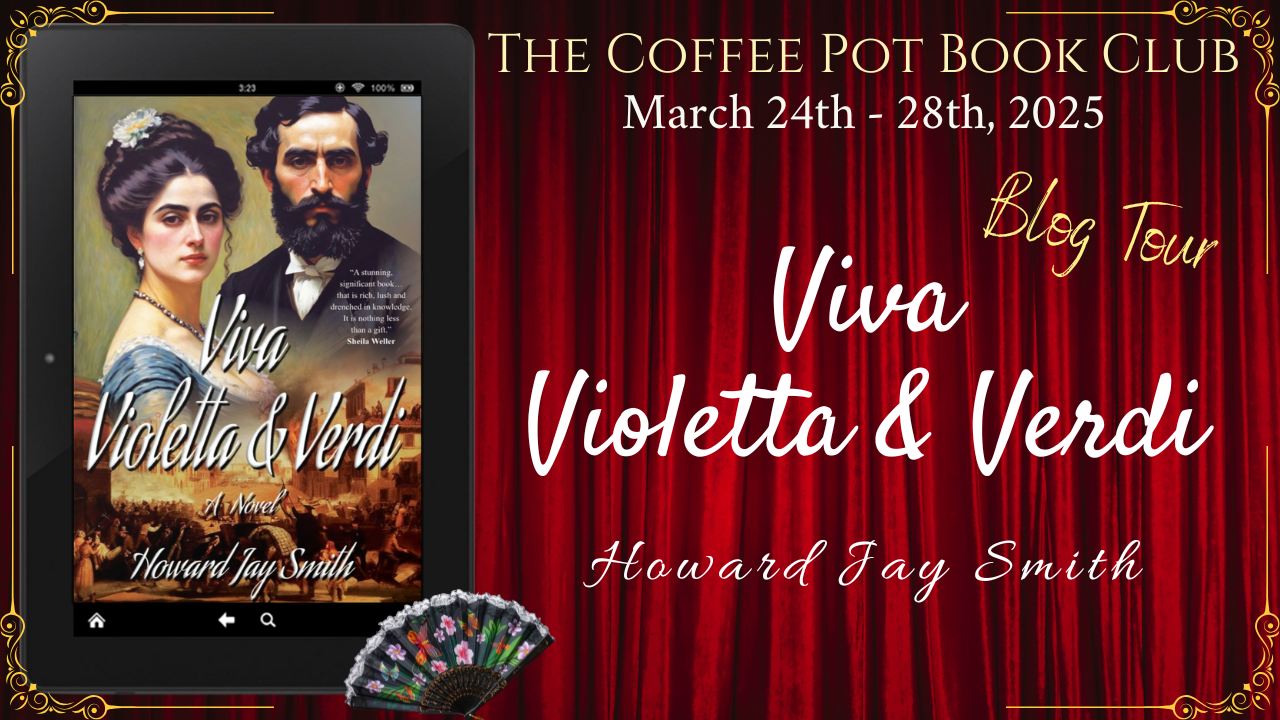
Book Title: Viva Violetta & Verdi
Series: N/A
Author: Howard Jay Smith
Publication Date: January 28th, 2025
Publisher: Historium Press
Pages: 256
Genre: Historical Fiction
Any Triggers: n/a
Twitter Handle: @cathiedunn @marylschmidt
Instagram Handle: @thecoffeepotbookclub
Hashtags: #HistoricalFiction #BiographicalHistoricalFiction #Verdi #ClassicalMusic #BlogTour #TheCoffeePotBook Club
Tour Schedule Page: https://thecoffeepotbookclub.blogspot.com/2025/02/blog-tour-viva-violetta-and-verdi-by-howard-jay-smith.html
Book Title and Author Name:
Viva Violetta & Verdi
by Howard Jay Smith
Blurb:
A Love Affair Inspiring the World’s Most Unforgettable Operas:
Experience the intense, lifelong love affair between Giuseppe Verdi and Giuseppina Strepponi, the brilliant and seductive soprano who shaped his legacy. As his muse, lover, and wife, Strepponi was the inspiration behind Verdi’s most iconic works, including La Traviata and Aida. Her influence was pivotal, as she became the architect of his creative triumphs and the heart of his operatic genius.
Set against the backdrop of Italy’s Risorgimento, this sweeping novel intertwines their turbulent relationship with the nation’s fierce struggle for independence. Through the heartbreak of three brutal wars, Verdi and Strepponi’s passion, betrayal, and artistic ambition come alive, mirroring the era’s fiery spirit.
Rich with themes of love, power, food, wine, and unrelenting passion, Viva Violetta & Verdi is an unforgettable exploration of art, resilience, and the enduring bond that transformed both an artist and a nation.
Praise for Violetta & Verdi:
“A stunning, significant book…that is rich, lush and drenched in knowledge. It is nothing less than a gift.” – Sheila Weller
“Smith’s historic drama embraces universal themes of class and religious persecution, and weaves gorgeous language with an intimate knowledge of Italian food, music, and political hypocrisy that contemporary readers will find irresistible.” – Jessica Keener
“Viva Violetta & Verdi is a well-researched love letter to Verdi; fans are sure to love.” – Leslie Zemeckis
“Perfection. You are right there, inhaling and breathing in the words, the smell, and each piece of music. Bravo. It is both a love song and a love letter to the irrefutable power of Verdi’s muse, Violetta.” – Amy Ferris
Viva Violetta & Verdi
The Shofar
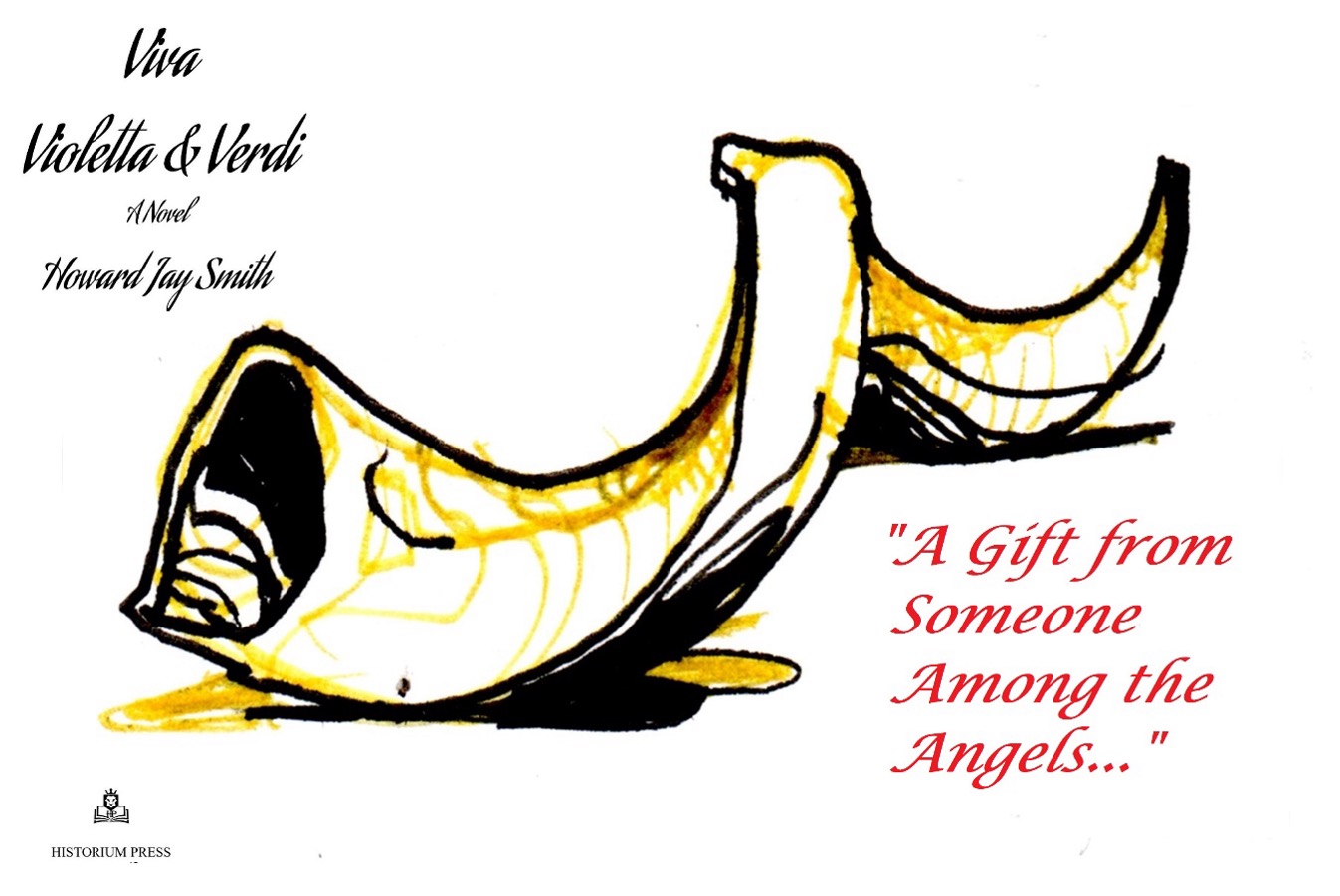
After Verdi and I settled into our seats in Box Thirteen, I opened the Rabbi’s package. Inside, wrapped in a blue velvet cloth bag was a letter, a silk scarf and the very shofar Verdi had admired in Busseto. I handed Verdi the ram’s horn and said, “This is a gift to you from Rabbi Spinoziano.”
Verdi was stunned. He held the shofar in his hands as delicately as if it were a sacred relic. “I can’t believe he gave me this. What do I do? How do I play it?”
“Oh, there are instructions,” I told him and then reading from the note, “The Rabbi writes, ‘Consider your destiny in this era of travail. When the time comes to destroy the walls of our enemies and bring down the emperors who oppress us, put your lips together and blow. If we are fortunate, your clarion calls will succeed. And if you fail, let’s hope reinforcements arrive in time to save us all.’”
“That’s it? That’s all? Your rabbi is quite the politician, isn’t he? And a comedian too. Yet when I was at your sinagoga I had the impression, that the shofar was only used for sacred rituals?”
“Sacred?” I laughed, “Rabbi Spinoziano is much like Giuseppe Mazzini, both are first and foremost humanists. To him, the only truly sacred things are those actions which serve to uplift and support people: love, truth, justice. Objects and rituals are not sacred. A horn is just a horn. It had one purpose when its first owner, the ram, lived, and another purpose when it was transformed into a musical instrument. According to the rabbi, only two types of people imbue these objects and the rituals surrounding them with purported magical powers. The first are the superstitious and weak-minded, and the second are the dictators and tyrants who exploit the fears of the first group so as to rule over them.”
“Your rabbi is a bit of a revolutionary too, eh?”
“Of course, being an outlier is the essence of being a Hebrew in a Christian world. Remember, fundamental to Judaism is our belief in the rule of law and equal justice for all – concepts that don’t exists when emperors, kings have some made up divine right to rule as they please. Our very existence is a thorn pricking the hand of the aristocracy and the clergy. And when it comes to taking up arms against the empire, trust me, the Jews of Italy are there.”
“Ah, I see, but doesn’t the shofar have a special place in your High Holidays?
“Yes, of course. But it’s not magic. It’s a horn, just a horn used to call the congregation together in an age before clocks or brass trumpets came into existence.”
“How very different from our churches where you cannot help but trip over one holy relic or another, bought and sold by the clerics. Does the good rabbi at least give any detailed instructions about how to play it?”
“Beyond putting your lips together? No. It takes some practice – just like we all learned to shoot rabbits with a hunting rifle growing up. That’s all.”
“And what’s that he sent you?” Verdi asked.
I pulled the scarf out of the package. It was a hand woven one made of pure white silk with some blue line running horizontally near the two ends. “It looks like a tallit, but it’s not,” I said as I put it on. The blue even matched that of my ever-present fedora. I looked further in the note to see if there was an explanation.
“What’s a tallit?” Verdi asked. “Is it that prayer shawl I saw the rabbi wearing at your wedding?”
I nodded, then read aloud from the rabbi’s note. “Dario, an apple does not fall far from the tree whence it came, but being round like a matzo ball, it can roll far away before being eaten by some beast. So, my friend, when in the silk weavers’ market of Ceneda, I found this scarf, one which reminds me of a tallit, but is not, I thought of you. May its gentle cloth keep you warm throughout your many travels while always reminding you of your roots.”
“You get a scarf; I get an enigma. That’s it?”
“There’s nothing more in here about the shofar. The rest of his letter is about our American cousin, Emanuele Conegliano, Mozart’s librettist, the one you know as Lorenzo Da Ponte.”
“Da Ponte? Is he still around?”
“No, apparently not. That’s what the letter reports. It seems that my cousin, the former Abbé Lorenzo Da Ponte, passed away in August of a year ago and was buried beside his wife, Celestina, in the graveyard of St. Patrick’s. He was eighty-nine, and had outlived Mozart by nearly fifty years. Imagine that.”
“Remarkable, what a life he led,” said Verdi. “Our opera world is deeply indebted to him and sadly few today recognize his genius. Without Da Ponte, there’d be no Mozart. Da Ponte’s home in Ceneda ought to be a shrine.”
“Truly, I added, “But not only did he create the libretti for Mozart’s best operas, he is the man who also introduced opera to America and started the first two theaters there in New York City. But there’s more here. Listen to this: The rabbi’s letter goes on to say that a month after his Catholic funeral, the Hebrew friends of Emanuele Conegliano and his family, secretly and out of sight of authorities, removed those coffins from St. Patrick’s and reburied them in the shade of an elm tree in the Jewish Cemetery of Shearith Israel. There, Emanuele and Celestina Conegliano will spend eternity in the company of their fellow Hebrew brethren in a land where the rule of law prevails over kings and their conspirators.”
This news about the secret reburial stunned Verdi to the core, even though I had long ago described to him all about Da Ponte’s life as a crypto-Jew.
“They did that? They actually did that? They reburied him? And in secret?”
“Yes, it was what he wanted. He told me that himself when I was there. He even showed me the spot he had picked out.”
“So, Da Ponte really did live a life behind masks and capes?”
“Yes, it was his solution to living in a world that is hostile to Hebrews.”
“And only in death could he return to himself?”
“Yes. It is true. He had to die to become a Jew again.”
“That’s tragic and a story worthy of an opera in and of itself. One I’d call The Secret Life of Lorenzo Da Ponte.”
“Yes, indeed. But he will be a Jew for eternity,” I said.
“Eternity?” Verdi laughed for the first time that day. “I don’t believe in that Heaven and Hell nonsense. When you’re dead, you’re dead, there’s no turning back.”
Verdi lifted the shofar up to his lips, but when he blew into it, naught came out except his sputtering. His eyes watered, he tried again, nothing. And then the tears began to flow. Verdi dropped the shofar onto the floor and then began to sob uncontrollable.
“Icilio!” he wailed, “Icilio! Why? Why?” Verdi buried his face in his hands and the tears flowed as wildly and fierce as those once portrayed in Violetta’s Lament.
**********
When the first act of Oberto ended with its curtain drop and a smashingly good round of applause, Verdi looked at me, his face a wild map of emotions. “Wait here. I have to see Margherita.”
Verdi scrambled out of our box and raced down the stairs until he reached the exit doors. He left La Scala at a gallop and then ran the half-dozen blocks all of the way back to his apartment on Via San Simeone. There, breathless, he found Margherita in the company of my Isabella, who was of course wearing that blue turquoise gown and the matching jacket.
Since the sudden death of Icilio four weeks earlier from a mysterious fever, Margherita had been inconsolable. Her grief had been so intense that not only was she unable to join us for the premiere, she had scarcely left their home since the funeral. And my Isabella, whose innate sense of empathy and compassion was unrivaled, insisted on staying by her side. If anyone understood, tragedy, it was my bride. She knew when to speak, when to be silent, when to listen and when to simply share tears. It went without saying that Isabella, who understood better than most what was truly important in our lives, would easily surrender the prospect of seeing her first opera to be in support and to be able console, Margherita.
Verdi hugged his wife in a long lingering moment of shared grief and then whispered, “It’s going well. A success, so far.”
Margherita could only manage the tiniest of smiles before collapsing again in tears.
Buy Link:
Universal Buy Link: https://books2read.com/u/bxyr2d
Author Bio:
Howard Jay Smith is an award-winning writer from Santa Barbara, California.
VIVA VIOLETTA & VERDI, is his third novel in his series on great composers, including BEETHOVEN IN LOVE; OPUS 139 and MEETING MOZART: FROM THE SECRET DIARIES OF LORENZO DA PONTE.
His other books include OPENING THE DOORS TO HOLLYWOOD (Random House) and JOHN GARDNER: AN INTERVIEW (New London Press). He was recently awarded a Profant Foundation for the Arts Fellowship for Excellence in Writing.
Smith is a former two-time Bread Loaf Scholar and three-time Washington, D.C. Commission for the Arts Fellow, who taught for many years in the UCLA Extension Writer’s Program and has lectured nationally. His articles have appeared in the Washington Post, American Heritage Magazine, the Beethoven Journal, Horizon Magazine, Fig Tree Press, the Journal of the Writers Guild of America, the Ojai Quarterly, and numerous trade publications. While an executive at the ABC Television, Embassy TV, and Academy Home Entertainment he worked on numerous film, television, radio and commercial projects.
He serves on the board of directors of the Santa Barbara Symphony and is a member of the American Beethoven Society.
Author Links:
Website: https://www.historiumpress.com/howard-jay-smith
Facebook: https://www.facebook.com/profile.php?id=100009914652603
Amazon Author Page: https://www.amazon.com/stores/Howard-Jay-Smith/author/B072FL7Y6P
Goodreads: https://www.goodreads.com/author/show/14208462.Howard_Jay_Smith





 When Angels Fly