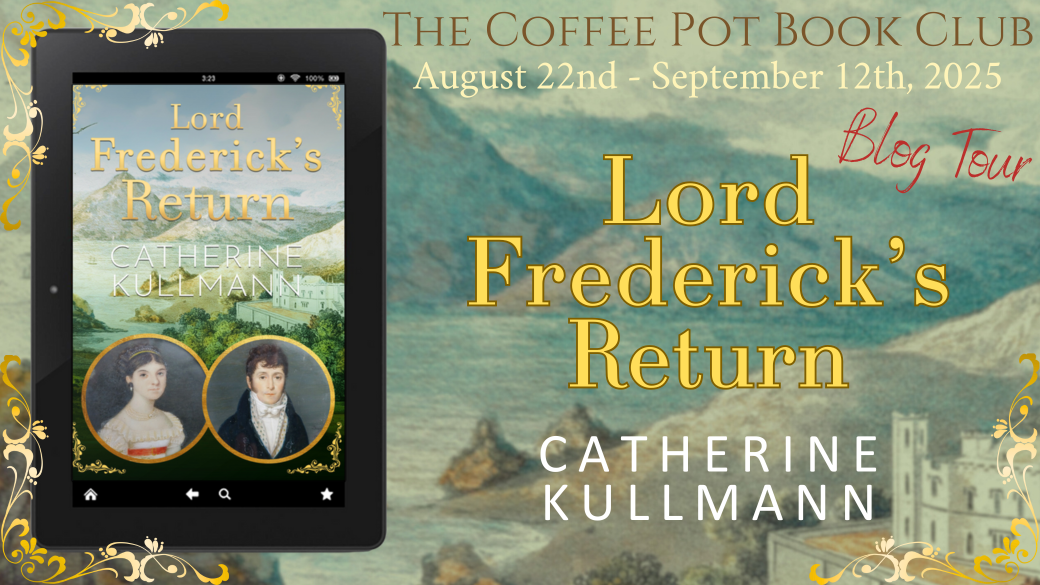
Name: Catherine Kullmann
Book Title: Lord Frederick’s Return
Series: n/a
Publication Date: 22nd July 2025
Publisher: Willow Books
Pages: 269
Genre: Regency Romance
Any Triggers: No
Twitter Handles: @CKullmannAuthor @cathiedunn @marylschmidt
Instagram Handle: @thecoffeepotbookclub
Hashtags: #Regency #HistoricalFiction #HistoricalRomance #BlogTour #TheCoffeePotBookClub
Tour Schedule Page: https://thecoffeepotbookclub.blogspot.com/2025/08/blog-tour-lord-fredericks-return-by-catherine-kullmann.html
Book Title and Author Name):
Lord Frederick’s Return
Catherine Kullmann
Blurb:
An older hero, an enigmatic heroine and a delightfully outspoken four-year-old. Throw scandal into the mix for a gripping and tender Regency love story.
August 1816. Lord Frederick Danlow returns to England after spending 18 years in India. He plans to make a home for himself and his motherless, four-year-old daughter, Ruperta. Unsure where to start, he accepts an invitation to stay at Ponsonby Place, home of Colonel Jack Ponsonby who made his fortune in India, and his daughter Susannah, the mistress of the household.
Soon Frederick finds himself in need of a governess—and a wife? The more time he spends with Susannah, the more his admiration of her deepens. Is she the woman with whom he will share his life?
He is resolved to court her, but then his younger brother Henry engulfs his family in an appalling scandal that could prevent any lady from agreeing to a connection with it. Now Frederick must support his family during this ordeal.
But what of Susannah? What will she say when she hears of the scandal? Should he, dare he offer her his heart and his hand?
Guest Post: When Angels Fly
Why Write or Read Historical Fiction?
What do we write and read historical fiction? First, I suppose, because it takes us out of ourselves—transports us to an unfamiliar society recreated partly from familiar facts and partly from a myriad of tiny, new details so that it seems as real to us as our world of today. The setting rings true and the characters’ actions are determined by the laws, morals and customs of their time, not ours. Sometimes this horrifies us; at other times we find it liberating and long for more romantic, more adventurous, perhaps simpler bygone days.
Contemporary fiction instinctively reflects/portrays the world as it is at the time of writing. Historical fiction considers the past through the prism of the present, the author drawing on research rather than personal experience to create an authentic setting and story. But, while we cannot forget what we already know—that Germany lost both world wars, that the Allies under Wellington won the Battle of Waterloo or that the US won the War of Independence,—reading the right author, we are willing to suspend our belief, to become so caught up in the story, that we experience those events as if they were happening today. And within these grand story arcs there are so many smaller arcs concerning fictional characters with uncertain outcomes or gaps in the known narrative that informed imagination can fill so that no matter how well we think we know a period or an episode, there is always something new to discover.
With history becoming more and more of a niche subject at schools and universities, it is historical fiction that offers millions of readers a connection to the past, a past which casts long shadows. We need only look back two hundred years to the beginning of the nineteenth century. The Act of Union between Great Britain and Ireland of 1800, the Anglo-American war of 1812 and the final defeat of Napoleon at the Battle of Waterloo in 1815 are all events that still shape today’s world. At the same time, the ruling aristocracies were being challenged by those who saw the need for social and political reform, while the industrial revolution which led to the transfer of wealth to the manufacturing and merchant classes was underway. Powerful voices demanded the abolition of the slave trade and women, who had few or no rights in a patriarchal society, had begun to raise their voices, demanding equality and emancipation. It is the beginning of our modern society.
Following the collapse of the Treaty of Amiens in 1803, the United Kingdom was at war with Napoleonic France until 1815. Like Hitler in 1939, Napoleon swept eastwards conquering all before him until he stood at the gates of Moscow. Unlike other combatants in this long war, Britain was spared the havoc wrought by an invading army and did not suffer under an army of occupation. War was something that happened elsewhere, far away. For twelve long years, ships carrying fathers, husbands, sons and brothers sailed over the horizon and disappeared. Over three hundred thousand men did not return, dying of wounds, accidents and illness.
What did this mean for those left behind without any news apart from that provided in the official dispatches published in the Gazette and what little was contained in intermittent private letters? The question would not leave me and it is against this background of an off-stage war that I have set my novels. How long did it take, I wondered, for word of those three hundred thousand deaths to reach the bereaved families? How did the widows and orphans survive? What might happen to a girl whose father and brother were ‘somewhere at sea’ if her mother died suddenly and she was left homeless?
It is against this backdrop of an off-stage war in a patriarchal world where women are both second-class citizens and held to impossibly high standards that I set my first novels. My characters and their stories are fictional but the world in which they live is very real and there are no twenty-first century solutions to their dilemmas. The main story arc is romantic; I am particularly interested in what happens after the first happy end—how life goes on around the protagonists and sometimes catches up with them. In The Murmur of Masks, Olivia agrees to a marriage of convenience, unaware that her husband’s secrets will prevent love ever growing between them. How can she build a satisfying life for herself? Perception & Illusion charts the voyage of newly-wed Lallie and Hugo through a sea of confusion and misunderstanding. Will they come to a safe harbour or continue to drift apart? And, in A Suggestion of Scandal, simply being in the wrong place at the wrong time puts Rosa’s whole future at risk. Could it happen today?
In later stories, such as The Potential for Love and A Comfortable Alliance, I consider the situation of those who fought or lost love ones during the long war. The war may be over, but life goes on. Lady Loring’s Dilemma and The Husband Criteria highlight the situation of married women whose legal existence is denied under the legal fiction of coverture. And finally, in Lord Frederick’s Return, the situation of children born out of wedlock to an Indian mother and English father and the implications of this for their fathers is considered.
Good historical fiction therefore informs us about the past. It provides insights into yesterday and helps us understand today. It encourages us to persevere or warns us to change direction. It can reveal past, hidden wrongs, teach us to value the struggles of those who went before us and inspire us to preserve and build upon their achievements.
© Catherine Kullmann 2025
Buy Link:
Universal Buy Link: https://mybook.to/Frederick

Author Bio:
Catherine Kullmann was born and educated in Dublin. Following a three-year courtship conducted mostly by letter, she moved to Germany where she lived for twenty-five years before returning to Ireland. She has worked in the Irish and New Zealand public services and in the private sector. Widowed, she has three adult sons and two grandchildren.
She has always been interested in the extended Regency period, a time when the foundations of our modern world were laid. She loves writing and is particularly interested in what happens after the first happy end—how life goes on for the protagonists and sometimes catches up with them. Her books are set against a background of the offstage, Napoleonic wars and consider in particular the situation of women trapped in a patriarchal society.
She is the author of The Murmur of Masks, Perception & Illusion, A Suggestion of Scandal, The Duke’s Regret, The Potential for Love , A Comfortable Alliance , Lady Loring’s Dilemma and The Husband Criteria.
She also blogs about historical facts and trivia related to this era. You can find out more about Catherine’s books and read the blog (My Scrap Album) at her website where you can also subscribe to her newsletter.
Author Links:
Website: http://www.catherinekullmann.com/
Twitter / X: https://twitter.com/CKullmannAuthor
Facebook: https://www.facebook.com/catherinekullmannauthor
Book Bub: https://www.bookbub.com/profile/catherine-kullmann
Amazon Author Page: viewauthor.at/ckullmannamazonpage
Goodreads: https://www.goodreads.com/author/show/15549457.Catherine_Kullmann
 When Angels Fly
Thanks so much for hosting Catherine Kullmann today, with such an interesting post linked to her fabulous new novel, Lord Frederick’s Return.
Take care,
Cathie xo
The Coffee Pot Book Club
LikeLiked by 1 person