Jefferson Ball, the mightiest female dog in a universe full of them.
Jody Ryder, the mightiest female robot dog in said universe.
When they clash, everyone will hear it….
My Review:
This book is chock full of robotic, two-legged, sporting, and talking dogs as well as a mix of alien creatures, some bad ones, and life, of sorts carries on. The two characters at the beginning are highly competitive, and they are actually in high school. The fantasy takes you up and down. Language can be coarse. It’s probably best for Readers 16 and up. The ending was a surprise.
The seaside has an undeniable power to bring peace and joy to the soul. Its treasures of shells, rocks, sea life, water, and sand captivate us with their beauty and remind us of the wonders of nature. The photographs of Derek R. King and the affirming words of his and Julie L. Kusma perfectly capture the essence of this magical place. Let the seaside inspire you and fill your heart with tranquility and happiness.
My Review:
The words contained within were soothing to my soul. I live in a landlocked state in the USA. The words within are mainly about the seaside, but I found them soothing and beneficial to my soul. Why, you might ask? I’ll tell you. The soft waves gently lapping, the beautiful shells and sea life, the throes of a tide, a setting sun, and more mixed with soothing verbiage does heal and soothe the soul. The combination of heartfelt words and soothing sound and scenes written within are just that. Soothing. No matter where you live, you will experience the fullness of the seaside.
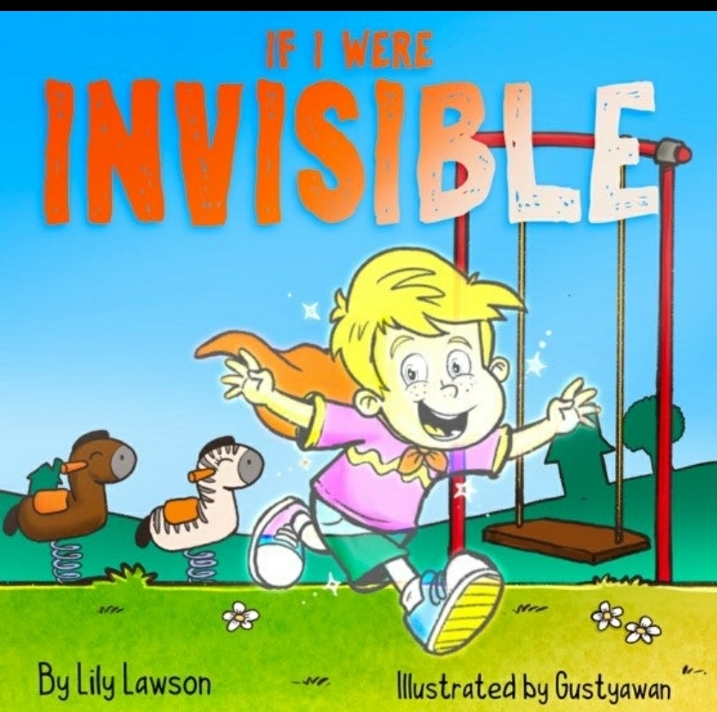
Think of all the things we could get away with if nobody could see us! But how long would the fun last, if we had to do it all alone?
My Review:
This is a very cute story for children. It rhymes and has a great theme for kids to explore. If I was invisible, what could I do? Kids would have a ton of ideas. Dreaming about what a kid could do is endless. But then, the kicker comes in to play. What fun would it be if a child no longer can see or play with family or friends? Food for thought for children.
In no mood for holiday cheer, songwriter Dalia Hayes is about to turn off the news when she sees Oliver, the man who recently deserted her, receive a Grammy nomination for a Christmas song Dalia had composed, and that he’s pirated.
Now she’s furious, in the depths of heartache, and is forced to play Nancy Drew to figure out how he pulled it off.
When she finds him, how is she supposed to prove it?
My Review:
This short story was a fun holiday read. If ever two people were meant to be together, Dalia and Ollie fit that to a T. Going from A to B is the fun part of the story that you must read for yourself.
Four breathtakingly romantic tales of a Regency Christmas from four bestselling romance authors.
Down through the years, enchantment touches a tall gray house in Grosvenor Square. The legend of Lady Winterson’s Christmas ball promises true love and happiness to one lucky couple. Who will feel the magic this winter?
1803 – The Seduction of a Duchess by Shana Galen
Rowena Harcourt, the Duchess of Valère, never forgot the handsome footman who helped her escape the French Revolution. For fourteen years, Gabriel Lamarque has loved Rowena—now at Lady Winterson’s Christmas ball, has fate finally delivered a chance to win her hand?
1818 – One Kiss for Christmas by Vanessa Kelly
Nigel Dash is London’s most reliable gentleman, a reputation he never minded until he fell in love with beautiful Amelia Easton. Unfortunately, Amelia sees Nigel as a dependable friend, not a dashing suitor. At Lady Winterson’s famous Christmas ball, Nigel vows to change Amelia’s mind—by sweeping her off her feet.
1825 – His Christmas Cinderella by Anna Campbell
At the season’s most glittering ball, a girl who has never dared to dream of forever after discovers a Christmas miracle.
1830 – The Last First Kiss by Kate Noble
Susannah Westforth has always loved Sebastian Beckett – but he’s only ever seen her as a friend. When Sebastian takes his Grand Tour, Susannah transforms herself into a woman he’ll notice. Now Sebastian is back, just in time for Lady Winterson’s Christmas ball – but the last thing he expects to see is his little Susie, all grown up…
You’re invited to join the whirling dance at Lady Winterson’s sparkling Christmas ball, where miracles happen and true love shines forever. How can you resist?
My Review:
Wow. Talk about an awesome way to find love matches at 3 Grosvenor. Christmas time is special, and more so if one has a highly covered invite to the Christmas ball and Lady Winterson’s ball is always a real crush. The different stories in this book involve Winterson’s Christmas ball, but each differ in presentation. Five stars!
During the fall of 1918, the influenza pandemic crosses the nation and reaches the mining town of Butte, Montana.
Marika Jovich, who wants to go to school to become a physician, works menial tasks for Dr. Fletcher. She feels useless as she tries to save friends and neighbors from the ravages of the flu. In the midst of the pandemic, she watches the town shut down, young and old perish, and her medical dreams all but evaporate.
Kaly Monroe used to be a half-good woman of the night. She left that life to raise her daughter, Annie, and live and work with her long-lost mother, Tara McClane. Kaly waits for her husband, Tommy, to return from the war. Word from the east is that soldiers are dying of influenza and she prays that Tommy is not one of them.
When an out-of-town woman named Amelia suddenly dies in Dr. Fletcher’s office, both women try to learn more about the mysterious woman and the circumstances regarding her death. Is she another casualty of the pandemic, or the victim of manmade foul play? Who is this stranger, and is her demise a portent of the fate that awaits the residents of Butte?
Praise for Beautiful Ghost:
“Marsenich doesn’t just describe the place and times, she conjures it up like time travel.” ~ Amazon Review by Ellen Leahy Howell
The wolf dog wanders through the town where mining fumes singe the air, and tin shacks, thrown together in desperation, sit next to French mansions and yards flagged with cobblestone. He rambles past the Cabbage Patch, where bootleggers and criminals live in downtrodden shanties and the king of the Patch rules the poor with an iron club. The dog walks through Dublin Gulch, a rough bit of Butte, inhabited by stubborn Irish people and sour-faced old women, who rarely shop for fine china or cast-iron pots at the town’s one department store. He continues his journey through Chinatown, past the opium dens, and down to the train depot on East Front Street.
He sits on the platform, under a center overhang, out of the rain, and watches the passengers disembark. Soot covers every surface of the depot, and, as the sky darkens, the wolf dog feels something coming. Something rising up out of the ground, on the wind, or perhaps in a blanket. Or maybe, a young woman carries it in her lap as the train roars across the country from the east to Montana. This tiny thing is barely a whisper. But it’s there, wanting to live and live strong. It floats among the people hugging and kissing in the depot’s large waiting room. It lights on jackets of men smoking, and hovers in the perfumed air where women tend to private matters.
Author Bio:
Milana Marsenich – Author Bio
Award winning author, Milana Marsenich lives in Northwest Montana near Flathead Lake at the base of the beautiful Mission Mountains. She enjoys quick access to the mountains and has spent many hours hiking the wilderness trails with friends and dogs. For the past 20 years she has worked as a mental health therapist in a variety of settings. As a natural listener and a therapist, she has witnessed amazing generosity and courage in others. She first witnessed this in her hometown of Butte, Montana, a mining town with a rich history and the setting for Copper Sky, her first novel.
Copper Sky was chosen as a Spur Award finalist for Best Western Historical Novel in 2018. Her second novel, The Swan Keeper, was a Willa Award finalist in 2019. Her short story, Wild Dogs, won the Laura Award for short fiction in 2020.
She has an M.Ed. in Mental Health Counseling from Montana State University and an MFA in Creative Writing from the University of Montana. She has previously published in Montana Quarterly, Big Sky Journal, The Polishing Stone,The Moronic Ox, BookGlow, and Feminist Studies.
She has three published novels, Copper Sky, The Swan Keeper, and Beautiful Ghost, and one popular history book, Idaho Madams. Her upcoming novel, Shed Girl: A Juliet French Novel, will be released January 2024. Her popular history book, Mary MacLane: Butte’s Wild Woman and her Wooden Heart, will be out sometime in 2025.
Her Alibi has been chosen by Author Shout as a Recommended read for 2024!Nice way to end the year.
Visions of her Cherokee grandmother, Cordie, flashed through Mary’s mind as her mother, Marguerite, informed her that her stepfather shot himself and was in the hospital. Oh no! Did she use me last night? She’d never use her scapegoat! No, she couldn’t! Even Marguerite wouldn’t sink that low! Or would she? Marguerite had always been abusive and vile to most people, and especially to her children and husbands, but would she shoot Harold? Chills raked Mary and triggered her shuddering. Was she more shocked that her mother shot her stepfather with murderous intent, or that she left Mary as her alibi?
Her Alibi – .99 cents only. On her third marriage to this man who didn’t deserve the traumas my mother dealt him. “Chills raked Mary and triggered her shuddering. Was she more shocked that her mother shot her stepfather, or that she left Mary as her alibi?” #TrueStory#TrueCrime#HerAlibi#murder in real life. Living with a murderer! Finally, the truth comes out about the psyche of a woman known as the “Black Widow”! I, @MaryLSchmidt , had the bollocks to write this story from the perspective being her daughter. The psyche of Marguerite is one for the books… just like the psyche of #BTK and others, I never knew the REAL danger living with this woman. No slander or libel to family as the only one who could sue me has been dead for 10 years! #RealLife#LivingWithAKiller#memoir
I just want to say that the book “Her Alibi” had to come out. Harold mattered! Everyone matters! But Harold mattered, especially to his three children, Alan, Scott, and Darrel. I don’t know your faith or what you believe, but I know what I experienced yesterday morning. I had a Heavenly visit while in my recliner. Without words, no physical anything seen, my right foot was touched with pressure for several seconds. It was Harold letting me know he felt validated, finally. He appreciated my hard work (bad memories) and effort to get this book out. I’m NOT doing this for money. I have money and I donate to many things, causes, and to people in need. But this story needed to be told. Harold mattered. If family are offended, well, not the first time, nor the last time. HAROLD MATTERED! And I hated being used as her da#m alibi. The TRUTH had to come out!
Reviewed by Astrid Iustulin for Readers’ Favorite Stories of abuse and domestic violence always shock you when you read them. This happens to anyone who reads Mary L. Schmidt’s book, Her Alibi. Here, the author tells the story of her family, focusing in particular on the abuses of her mother, Marguerite, who had always treated her as a scapegoat. After divorcing her husband, Marguerite marries Harold (she will marry him three times, to be exact) and is most likely responsible for his death. Is it possible she used her daughter as an alibi? And how will relations between Marguerite and her children develop? Her Alibi tells a disturbing story of an abusive mother and the consequences her mental condition and behavior have on her family and children, especially the daughter she treats as a scapegoat. Mary L. Schmidt tells us this story in a way that clearly depicts the world of abuse that characterized her childhood and gives the reader a precise understanding of what she and her siblings went through. Marguerite is represented in such a way that her personality deeply impresses the reader, especially considering what she may have done to Harold and her daughter, the alibi. I appreciated that Schmidt included many photos of her family because this makes you know the people she describes and makes you even more sympathetic to what they have experienced. Her Alibi is not a book for the faint of heart, and I recommend it to readers who have the courage to read it, to match the courage the author had in writing it.
Amazon Number One Bestseller – 2022
Literary Titan – Gold – 2022
SoCal Book Awards – Honorable Mention – 2022
Reader’s Choice Book Awards – Finalist 2023
London Book Awards – Honorable Mention 2023
Los Angeles Book Awards – Honorable Mention 2023
Author Shout Reader Ready Award Winner – Recommended Reads 2024
A lovely cameo brooch is discovered in Fiona’s late Uncle Wilbur’s house two days before Christmas. The pin bears a romantic Christmas message from Wilbur for his new wife with the initials, D.A.S. How very strange. To the family’s knowledge, Uncle Wilbur had never been married. So, who is this mysterious woman? Now, Fiona is on a holiday mission to locate D.A.S. and deliver the belated gift. Question is, what happened to the marriage? Is D.A.S. still alive after all these years? And if so, can Fiona find her before Christmas?
My Review:
This short story is a sweet Christmas read with a couple of cameos thrown into the mix. Love happens, and with love comes heartbreak, too. As a short story, I can’t write much, or I give the story away, and I don’t want that to happen.
In 1892, running one of the West’s fanciest brothels is a rough game. In a town filled with brazen criminals, corrupt police, zealous politicians, and morality committees, Madam Mattie Silks makes her fortune catering to Colorado’s gold and silver millionaires.
Notorious crime boss “Soapy” Smith is at the top of the Denver underworld. There are no rules for Smith’s gang. They solve problems with bribes and bullets. When Mattie’s husband stumbles into Soapy’s dealings, she struggles to protect him.
Gold is discovered in the Yukon and Mattie seizes the opportunity for adventure and profit. But Skagway, Alaska, is even more lawless than Denver. Mattie must use all her business sense and street smarts to safeguard those she cares about. Will it be enough? Or will Lady Justice again turn a blind eye?
Based on a true story, The Redemption of Mattie Silks is an action-packed tale of a woman succeeding in a man’s world even when the cards are stacked against her.
“The research on the era shines through, as do the grit and spirit of the characters. …A colorful and enthralling journey.”
~ K.T. Blakemore, award-winning author of The Good Time Girlsseries
“A nice, nuanced portrait of the complex underworld with fine and witty turns of phrase. A great Western romp!”
~ Randi Samuelson-Brown, award-winning author of TheBad Old Daysseries
Women of the Old West
Women of the Old West were pioneers and trailblazers, but not just in the sense that they gave up their homes and trekked into the wilderness. They also blazed trails in business, were pioneers of medicine and groundbreakers in politics.
Remember the old US Army advertising campaign: “We do more before 9AM than most people do all day”? My great-grandmother could have given any soldier a run for their money. With a baby on her hip and five more little ones trailing behind, she packed her valuables into a wagon and walked from North Carolina to Colorado. She spent the rest of her life on a homestead in the Colorado foothills, keeping the house and raising three more babies while also completing a man’s day’s work out on the range. She may have accomplished more before any given sunrise than I do in a good year. Sadly, stories of her and other remarkable but unknown heroines are being lost in the fog of history.
There were few acceptable careers for women in the 1800s, and certainly none that created wealth. Most working women struggled on subsistence earnings as laundresses, cooks, maids, or teachers. But in the West, where survival often depended on everyone pulling their weight, women could not afford to be shrinking violets. Their husbands and communities needed all hands to pitch in. The move west wrenched women from the customs, conventions, standards, and traditions with which they had been raised. They had to develop new codes of acceptable behavior, dress, and mores. In my novel The Mrs. Tabor, a local madam explains that a woman alone can act with the highest decorum and in the end, she will politely starve to death. The madam warns, “The law of survival always trumps the rules of etiquette.”
The need for labor gave Western women opportunities to create careers that their sisters in the East did not have. Women were often good with livestock, and ran cattle ranches, bred horses, or drove pack mules. It is estimated that 15% of homesteaders were single women. In an era when women could not sign a legal contract or open a bank account, female entrepreneurs owned restaurants, stores, and hotels in frontier towns.
In the mining boomtowns, most men preferred prospecting to planning infrastructure. This opened the door for the few women there to participate in government and improve the living conditions for their families and communities. In fact, many Old West towns lacked a school and church until the females organized the funding and building of these cultural institutions. White men may have explored the West, but white women settled it.
Western women also participated in politics decades before the constitution was amended to allow voting for all, regardless of sex. Wyoming Territory passed a women’s voting act in 1869, and the gals got right to work. Within a year the territory had female jury members, a bailiff and a justice of the peace. Other states and territories west of the Mississippi soon followed suit and women were voting in Colorado by 1893 and in Utah by 1896.
In a region where males greatly outnumbered females, some lonely men were of the opinion that woman’s suffrage might attract quality marriage candidates. Daring and hardy adventuresses would be drawn to a new life in the Wild West in they had a hand in shaping it. Delicate flowers accustomed to a steady life of comfort need not apply.
When their Eastern sisters were marching for the right to vote in matching white dresses, Western women were campaigning to be elected to public office themselves. All-lady town councils were elected in Oskaloosa, Kansas (1888) and Kanab, Utah (1912). In 1920, the same year that the 19th Amendment was finally ratified, Jackson, Wyoming elected an all-female mayor and city council. One of their descendants wrote, “There was a practical approach to it. [They said] we need this and we’ll do it ourselves.” Dubbed the Petticoat Rulers, they extended electric service, installed street lights, grated streets, created a town cemetery, collected taxes, and appointed a (female) town treasurer, marshal, and health officer.
Medical schools were graduating a handful of token female doctors in the late 1800s. Many of those found acceptance in the rough western territories. Perhaps citizens felt a lady doctor was better than no doctor at all. The television show Dr. Quinn, Medicine Woman was loosely based on the life of Doc Susie who served small mountain towns in the Colorado Rockies from 1893 until 1956. Imagine the patients she must have treated in a region filled with wild animals and wilder men. Her story and that of a few other early medical professionals are noted in state historical society collections, but most are unknown in the wider world.
Some women found work on the wrong side of the law. Pearl Hart robbed stagecoaches. Belle Star led a gang of cattle rustlers. Sing Choy, also known as China Mary, controlled the opium dens and Chinese prostitution in old Tombstone. The main character of my latest book, Mattie Silks, used her sharp business acumen to run one of Denver’s most successful brothels for over forty years.
Regardless of where they found employment, the women of the Old West displayed an incredible work ethic and courage enough to fill a library with adventure stories. But there is another, less glamorous trait they seemed to possess — pragmatism. If there was work to be done, they simply got to it. I don’t think many of the women who settled the wild frontier took any time to reflect on accomplishments or bask in any congratulatory accolades. There were few philosophical debates about equality of ability or opportunity. They were too busy, living by the motto, “Get ’er done!”
Buy Links:
This title is available to read with #KindleUnlimited
Kimberly Burns grew up in Colorado hearing stories about the colourful characters of the Old West. She has degrees from the University of Colorado and the University of Hartford. Kimberly is a member of the Historical Novel Society, Western Writers of America, and Women Writing the West. She lives with her husband and black Lab in Leesburg, Virginia.
Her debut novel The Mrs. Tabor won numerous awards including the Western Fictioneers Peacemaker Award for Best New Novel, a gold medal for Best Regional Fiction from the IndependentPublisher Book Awards, a National Indie Excellence Award, and a silver medal from the Colorado Independent Publishers Association EVVY Awards.
Kimberly and her unruly heroines make for an entertaining book talk. She is available to discuss her novels with book groups in person or online. Email her at info@kimberlyburnsauthor.com.
Life on Molly is a travel and lifestyle blog. I am a normal girl with many passions. I am an explorer of new places, a learner of new languages, creator of my ambitions, blogger, and a good pal. This blog is my little corner of the world where I am able to share my adventures with you and inspire you to live a life full of purpose.








 When Angels Fly