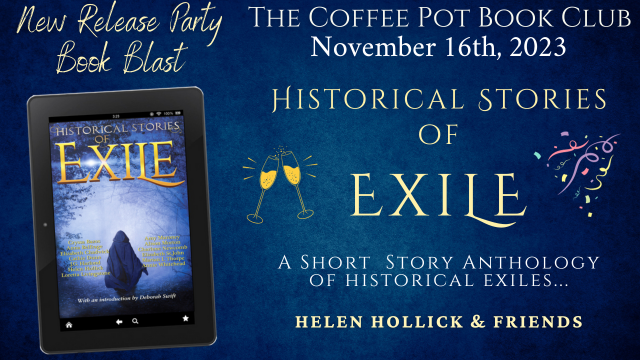
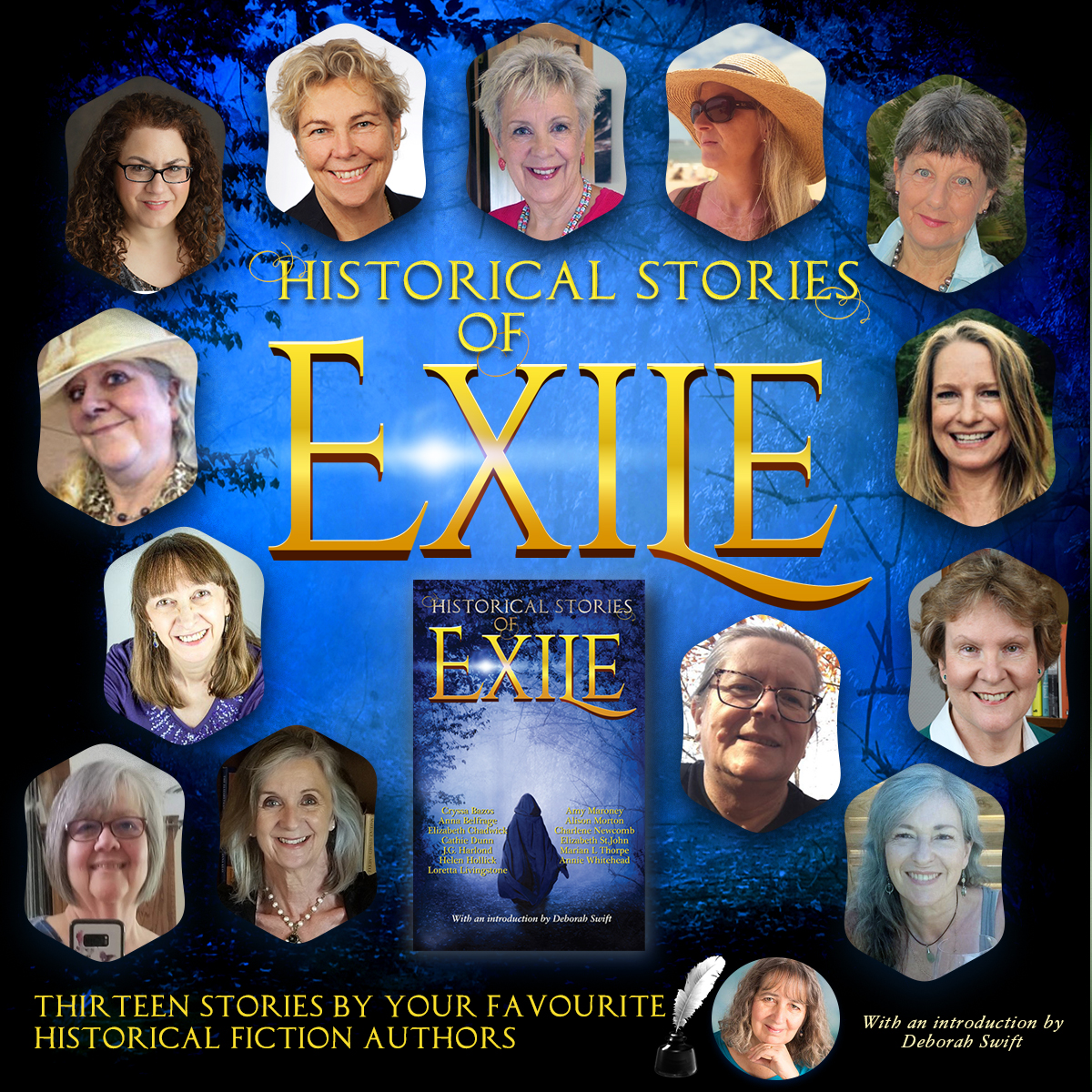
Book Title: Historical Stories of Exile
Authors: Cryssa Bazos, Anna Belfrage, Elizabeth Chadwick, Cathie Dunn, J G Harlond,
Helen Hollick, Loretta Livingstone, Amy Maroney, Alison Morton, Charlene Newcomb, Elizabeth St.John, Marian L. Thorpe, Annie Whitehead.
With an introduction by Deborah Swift
OFFICIAL LAUNCH PARTY Date: 16th November 2023
Publisher: Taw River Press
Page Length: 323
Genre: Historical Fiction / Short Story Anthology
Twitter Handle: @HelenHollick @cathiedunn
Instagram Handle: @thecoffeepotbookclub
Bluesky Handle: @cathiedunn
Hashtags: #ExileAnthology #HistoricalFiction #Exile #NewRelease #BookBlast #TheCoffeePotBookClub
Tour Schedule Page: https://thecoffeepotbookclub.blogspot.com/2023/10/blog-tour-historical-stories-of-exile.html
Book Title and Author Names:
Historical Stories of Exile
Contributing Authors:
Cryssa Bazos, Anna Belfrage, Elizabeth Chadwick, Cathie Dunn, J G Harlond,
Helen Hollick, Loretta Livingstone, Amy Maroney Alison Morton, Charlene Newcomb, Elizabeth St.John, Marian L. Thorpe, Annie Whitehead.
With an introduction by Deborah Swift.
Blurb:
Exile: a risky defiance, a perilous journey, a family’s tragic choice – or an individual’s final gamble to live. Exile: voluntary or enforced, a falling-out between friends, a lost first love, a prejudiced betrayal – or the only way to survive persecution?
In this historical fiction anthology thirteen authors (they are not superstitious!) have written exclusive short stories on the theme of exile. Some are based on true history, others are speculative fiction. All mine the depths of human emotions: fear, hope, love, and the fortitude to survive.
Join an inspiring Anglo-Saxon queen of Wales, a courageous Norwegian falconer, and a family fleeing back in time to escape the prospect of a ruthless future. Oppose the law with the legendary Doones of Exmoor, or defy the odds with two brave WWII exiles. Meet a Roman apprehensively planning exile to preserve the ‘old ways’, and a real Swedish prince forcibly expelled in heart-wrenching circumstances. Thrill to a story based on the legend of Robin Hood, sail with a queen of Cyprus determined to regain her rightful throne; escape religious persecution, discover the heart-rending truth behind the settlement of Massachusetts and experience the early years that would, eventually, lead to the founding of Normandy. Experience the stirring of first love, and as an exclusive treat special guest author, Elizabeth Chadwick, reveals a tale about the 12th-century’s heiress, Isabelle de Clare, and the Greatest Knight of all time – William Marshal.
With an introduction by multi-award-winning author Deborah Swift, enjoy these tales of exile across the ages. Some are hopeful, some sad, some romantic, some tragic, but all explore the indomitable spirit of resolute, unforgettable characters.
Buy Links:
This title is available to read on #KindleUnlimited
Universal Link: https://mybook.to/StoriesOfExile
About the Authors:
ALISON MORTON writes award-winning thrillers featuring tough but compassionate heroines. Her ten-book Roma Nova series is set in an imaginary European country where a remnant of the ancient Roman Empire has survived into the 21st century and is ruled by women who face conspiracy, revolution and heartache but use a sharp line in dialogue. Several of her novels have hit #1 in Amazon US, UK, Canada and Australia. The latest, Julia Prima, plunges us back to AD 370 when the founders of Roma Nova met.
She blends her fascination for Ancient Rome with six years’ military service and a life of reading crime, historical and thriller fiction. On the way, she collected a BA in modern languages and an MA in history.
Alison now lives in Poitou in France, the home of Mélisende, the heroine of her two contemporary thrillers, Double Identity and Double Pursuit. Oh, and she’s writing the next Roma Nova story.
Website: https://www.alison-morton.com
AMY MARONEY studied English Literature at Boston University and worked for many years as a writer and editor of nonfiction. She lives in Oregon, U.S.A. with her family. When she’s not diving down research rabbit holes, she enjoys hiking, dancing, traveling, and reading. Amy is the author of The Miramonde Series, a bestselling historical mystery trilogy about a Renaissance-era female artist and the modern-day scholar on her trail. Amy’s award-winning historical adventure/romance series, Sea and Stone Chronicles, is set in medieval Rhodes and Cyprus.
An enthusiastic advocate for independent publishing, Amy is a member of the Alliance of Independent Authors and the Historical Novel Society.
Website: https://www.amymaroney.com/
ANNA BELFRAGE Had Anna been allowed to choose, she’d have become a time-traveller. As this was impossible, she became a financial professional with three absorbing interests: history, romance and writing. Anna always writes about love and has authored the acclaimed time travelling series The Graham Saga, set in 17th century Scotland and Maryland, as well as the equally acclaimed medieval series The King’s Greatest Enemy which is set in 14th century England. Anna is presently hard at work with her other medieval series, The Castilian Saga ,which is set against the conquest of Wales. The third instalment, Her Castilian Heart, was published in 2022, and the fourth and final one will be out in 2024. She has recently released Times of Turmoil, a sequel to her time travel romance, The Whirlpools of Time.
Website, www.annabelfrage.com
ANNIE WHITEHEAD is an author, historian, and elected Fellow of the Royal Historical Society, and has written four award-winning novels set in Anglo-Saxon England. She has contributed to fiction and nonfiction anthologies and written for various magazines, has twice been a prize winner in the Mail on Sunday Novel Writing Competition, and won First Prize in the 2012 New Writer Magazine’s Prose and Poetry Competition. She was a finalist in the 2015 Tom Howard Prize for Nonfiction and was shortlisted for the Exeter Story Prize/Trisha Ashley Award 2021.
She was the winner of the inaugural Historical Writers’ Association/Dorothy Dunnett Prize 2017 and is now a judge for that same competition. She has also been a judge for the HNS (Historical Novel Society) Short Story Competition.
Her nonfiction books are Mercia: The Rise and Fall of a Kingdom (Amberley Books) and Women of Power in Anglo-Saxon England (Pen & Sword). She has contributed to a new history of English Monarchs, Kings and Queens: 1200 Years of English and British Monarchs (Hodder & Stoughton) and has signed a contract to write her third nonfiction book, to be published by Amberley books in 2024.
Website: https://anniewhiteheadauthor.co.uk/
CATHIE DUNN writes historical fiction, mystery, and romance. The focus of her novels is on strong women through time. She has garnered awards and praise from reviewers and readers for her authentic description of the past. A keen Medievalist, she enjoys visiting castles and ruins, and reading about battles and political shenanigans of the times.
Cathie is a member of the Historical Novel Society, the Romantic Novelists’ Association, and the Alliance of Independent Authors. She also now runs The Coffee Pot Book Club, promoting historical fiction authors and their books.
Website: https://www.cathiedunn.com
CHARLENE NEWCOMB writes historical fiction and science fiction. Her award-winning Battle Scars trilogy is set in the 12th century during the reign of Richard the Lionheart. Her writing roots are in the Star Wars Expanded Universe (aka Legends) where she published 10 short stories in the Star Wars Adventure Journal. Scifi/space opera fans should check out Echoes of the Storm, her original novel published in 2020. She returned to medieval times with her novel Rogue in 2023.
Website: https://charlenenewcomb.com
CRYSSA BAZOS is an award-winning historical fiction author and a 17th-century enthusiast. Her debut novel, Traitor’s Knot is the Medalist winner of the 2017 New Apple Award for Historical Fiction and a finalist for the 2018 EPIC eBook Awards for Historical Romance. Her second novel, Severed Knot is a B.R.A.G Medallion Honoree and a finalist for the 2019 Chaucer Award. Rebel’s Knot, the third instalment of the standalone series, Quest for the Three Kingdoms, is a B.R.A.G Medallion Honoree and 2021 Discovering Diamonds Book of the Year..
Website: https://cryssabazos.com
DEBORAH SWIFT is a delver into archives, drinks too much tea, and loves antiques and old buildings. Her sturdy, stone-built house used to be the village primary school, and from her window she has a view of a few 17th century cottages, and behind those, green fields dotted with grazing sheep.
Historical fiction was a natural choice for Deborah as a writer because she always enjoyed the research aspect of design – poking about in archives and museums, not to mention the attraction of boned bodices and the excuse to visit old and interesting buildings.
She used to work as a set and costume designer for theatre and TV, so enjoy the research aspect of creating historical fiction. She likes to write about extraordinary characters set against the background of real historical events. In her books Deborah likes to write about extraordinary characters set against the background of real historical events. Her first novel was The Lady’s Slipper which was shortlisted for the Impress Prize, and her book The Poison Keeper, about the Renaissance poisoner Giulia Tofana, won the BookViral Millennium Award. She has written eighteen novels to date including two series set in WWII – her latest, The Shadow Network is due for release in early 2024.
Deborah lives in North Lancashire on the edge of the Lake District, and divide her time between teaching and writing.
Website: https://deborahswift.com/
ELIZABETH CHADWICK New York Times bestselling author Elizabeth Chadwick lives in a cottage in the Vale of Belvoir in Nottinghamshire with her husband and their four terriers, Pip, Jack, Billy and Little Ted. Her first novel, The Wild Hunt, won a Betty Trask Award and To Defy a King won the RNA’s 2011 Historical Novel Prize. She was also shortlisted for the Romantic Novelists’ Award in 1998 for The Champion, in 2001 for Lords of the White Castle, in 2002 for The Winter Mantle and in 2003 for The Falcons of Montabard. Her sixteenth novel, The Scarlet Lion, was nominated by Richard Lee, founder of the Historical Novel Society, as one of the top ten historical novels of the last decade. She often lectures at conferences and historical venues, has been consulted for television documentaries and is a member of the Royal Historical Society.
Website: https://elizabethchadwick.com/
ELIZABETH ST.JOHN’s critically acclaimed historical fiction novels tell the stories of her ancestors: extraordinary women whose intriguing kinship with England’s kings and queens brings an intimately unique perspective to Medieval, Tudor, and Stuart times.
Inspired by family archives and residences from Lydiard Park to the Tower of London, Elizabeth spends much of her time exploring ancestral portraits, diaries, and lost gardens. And encountering the occasional ghost. But that’s another story.
Living between California, England, and the past, Elizabeth is the International Ambassador for The Friends of Lydiard Park, an English charity dedicated to conserving and enhancing this beautiful centuries-old country house and park. As a curator for The Lydiard Archives, she is constantly looking for an undiscovered treasure to inspire her next novel.
Elizabeth’s books include her trilogy, The Lydiard Chronicles, set in 17th Century England during the Civil War, and her medieval novel, The Godmother’s Secret, which explores the mystery of the missing Princes in the Tower of London.
Website: http://www.elizabethjstjohn.com/
HELEN HOLLICK and her husband and adult daughter moved from north-east London in January 2013 after finding an eighteenth-century North Devon farmhouse through being a ‘victim’ on BBC TV’s popular Escape to The Country show. The thirteen-acre property was the first one she was shown – and it was love at first sight. She enjoys her new rural life, and has a variety of animals on the farm, including Exmoor ponies, dogs, cats, hens, ducks and geese and her daughter’s string of show jumpers.
First accepted for publication by William Heinemann in 1993 – a week after her fortieth birthday – Helen then became a USA Today Bestseller with her historical novel, The Forever Queen (titled A Hollow Crown in the UK) with the sequel, Harold the King (US: I Am the Chosen King), novels that explore the events that led to the Battle of Hastings in 1066. Her Pendragon’s Banner Trilogy is a fifth-century version of the Arthurian legend, and she also writes a pirate-based nautical adventure/fantasy series, The Sea Witch Voyages, where you can read more about Jesamiah Acorne, son of Charles St Croix – and the Doones.
Despite being impaired by the visual disorder of Glaucoma, she is also branching out into the quick read novella, ‘Cosy Mystery’ genre with the Jan Christopher Mysteries, set in the 1970s, with the first in the series, A Mirror Murder incorporating her, often hilarious, memories of working for thirteen years as a library assistant.
Her non-fiction books are Pirates: Truth and Talesand Life of a Smuggler. She also runs a news and events blog and a Facebook page for her village, and supports her daughter’s passion for horses and showjumping – and occasionally gets time to write…
Website: https://helenhollick.net
J.G. HARLOND Secret agents, skulduggery, and crime that crosses continents.
British author of historical crime fiction, J.G. (Jane) Harlond writes award-winning, page-turning novels set in the mid-17th and mid-20th centuries. Each story weaves fictional characters into real events. She describes her WWII Bob Robbins Home Front Mysteries as ‘cosy crime with a sinister twist’. Prior to becoming a full-time author, Jane taught English and World Literature in international colleges. She also wrote school text books for many years using her married name.
Jane is married to a retired Spanish naval officer and they have a large, grown-up family living in various parts of Europe and the USA. After travelling widely (she has lived in or visited most of the places that feature in her novels) they are now settled near Málaga in Spain.
J.G. Harlond is a member of the British Crime Writers Association and the Dorothy Dunnett Society.
Website: http://author.to/JGHarlond
LORETTA LIVINGSTONE had no intention of writing anything but short stories or poetry, and especially not historical fiction. She stated it quite clearly on social media, only to suddenly find herself writing … historical fiction. Her debut novel, Out Of Time, set in the mythical Sparnstow Abbey, was shortlisted for the Historical Novel Society Indie Award in 2016, which stunned and elated her in equal measures.
It was supposed to be a one-off. It wasn’t. She went on to write two more stand-alone novels in the series; A Promise to Keep and Blossom on the Thorn. She had plans for more but has had ME for many years, and ill health has temporarily reined in her gallop. However, she intends to write again soon…
Her other books include short story collections and poetry, and can be found on Amazon.
Loretta is on Facebook: https://www.facebook.com/groups/217686418294125
MARIAN L. THORPE Taught to read at the age of three, words have been central to Marian’s life for as long as she can remember. A novelist, poet, and essayist, Marian has several degrees, none of which are related to writing. After two careers as a research scientist and an educator, she retired from salaried work and returned to writing things that weren’t research papers or reports.
Marian’s first published work was poetry, in small journals; her first novel was released in 2015. Her award-winning Empire’s Legacy series is historical fiction of another world, based to some extent on northern Europe after the decline of Rome.
In addition to her novels, Marian has read poetry, short stories, and nonfiction work at writers’ festivals and other juried venues.
Her other two passions in life are birding and landscape history, both of which are reflected in her books. Birding has taken her and her husband to all seven continents, but these days she’s mostly content to move between Canada and the UK.
Website: https://marianlthorpe.com/