Name: Judith Arnopp
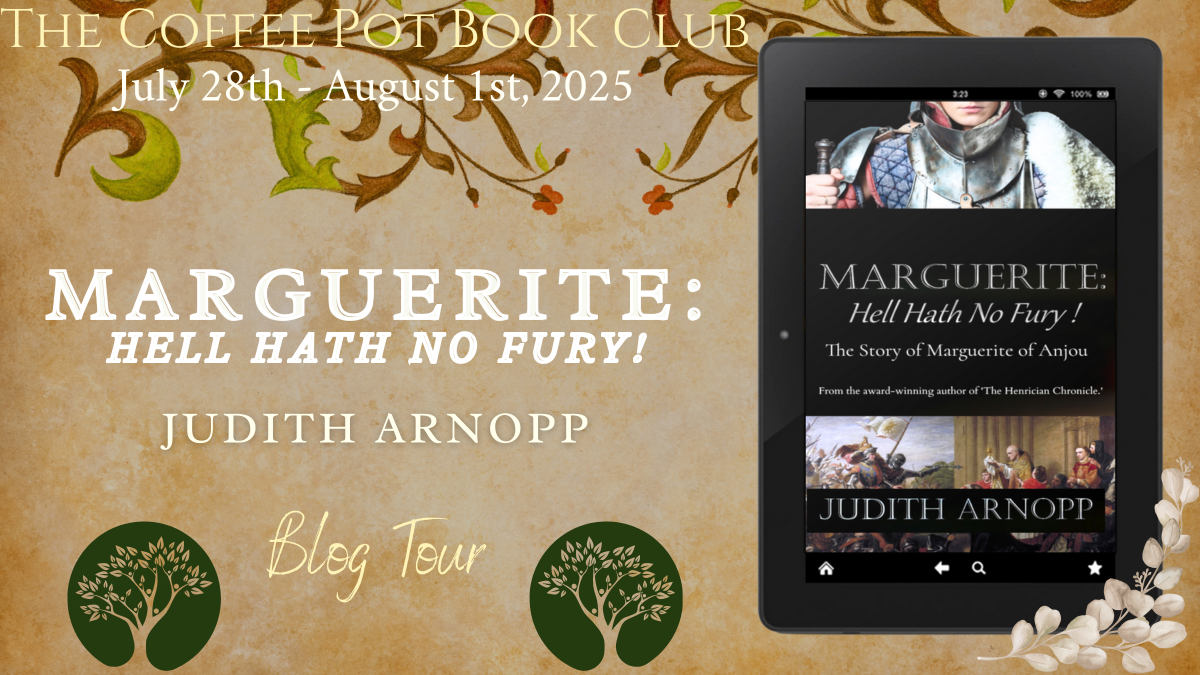
Book Title: Marguerite: Hell Hath No Fury!
Series: n/a
Publication Date: June 21st, 2025
Publisher: independently published
Pages: 342
Genre: Historical Fiction / Biographical Fiction
Any Triggers: n/a
Twitter Handle: @JudithArnopp @cathiedunn @marylschmidt
Instagram Handle: @tudor_juditharnopp @thecoffeepotbookclub
Hashtags: #HistoricalFiction #BiographicalFiction #WarsOfTheRoses #MargueriteOfAnjou #BlogTour #TheCoffeePotBookClub
Tour Schedule Page: https://thecoffeepotbookclub.blogspot.com/2025/06/blog-tour-marguerite-by-judith-arnopp.html
Book Title and Author Name:
Marguerite: Hell Hath No Fury!
by Judith Arnopp
Blurb:
Marguerite: Queen of England
From the moment Henry VI’s new queen, Marguerite of Anjou, sets foot on English soil she is despised by the English as a foreigner, and blamed for the failures of the hundred years war in France.
Her enemies impede her role as the king’s consort and when Henry sinks into apparent madness, her bid to become regent is rejected. Marguerite must fight, not only for her own position but to maintain Henry’s possession of the crown.
The ambitious Duke, Richard of York, seizes control of the country, thrusting Marguerite aside and inflating the mutual hatred between the houses of York and Lancaster. But the queen refuses to relinquish power and fights determinedly for the rights of her son, Edward of Lancaster.
The long and bitter civil conflict, that has come to be known as the War of the Roses, commences.
Excerpt 2:
Marguerite is in exile and has reluctantly agreed to an alliance with her old enemy the Earl of Warwick against Edward of March, who is now wearing her husband’s stolen crown.
July 1470
I know what is required of me. I must welcome the Earl of Warwick and forgive the numerous injuries he has inflicted on me and mine. To gain my heart’s desires I must embrace him as a friend and ally. It sounds a simple cure. Just one small spoonful of vile medicine to relieve years of discomfort but, by God, the pain of the remedy almost supersedes any other I have felt. I am not sure I can swallow it.
I try to refuse, find another way, but all my advisers urge me to conceal my pride and look beyond this moment and concentrate on the image of my son, his handsome face topped with the crown of England.
My glory.
Reluctantly, I agree to try.
Jasper and Exeter wait with me for the earl to arrive. My stomach is full of snakes that writhe and burn. I want to run. I want to vomit up this idea of a union between my son and the earl’s daughter. Oh, how I wish we had impaled Warwick’s head alongside York’s on the Micklegate Bar when we had the chance.
We can only do what we can do.
The world outside the chamber stirs, I hear footsteps, confident and masculine – determined. My determination quails as the doors are thrown open and I hear the sound of heels on marble. I raise my head and open my eyes, steeled for the sight of Satan as he comes slithering into my presence.
And there he is.
He swirls his cloak behind him, his hand on his sword hilt as he makes an overly extravagant bow. Does he mock me? I do not move. I keep my eyes fixed on the far wall. Long moments pass before the arrogant swine realises he should be on his knees. As I hear him lower himself to the ground, I cannot resist looking as he bows his disgusting head in fealty to me. It is something I never thought to see.
“Your Grace. I am honoured and gratified that you agreed to discuss this matter.”
He is indeed a prince of falsehoods. For all my faults, I have never been less than honest. I would trust him more were he to admit his detestation for me. I can work to the same ends with a man who hates me. I see no need for lies.
Unable to bring my lips to form amiable words, I merely stare at the back of his lowered head.
If I had a sword, I would use it.
Edward stirs beside me, nudges me to respond, but it is as if I am trapped in this moment. I should speak, I should bid him rise, allow him to kiss my fingers, and let the negotiations begin, but I cannot.
The faces of all those I have lost, those Warwick killed, rise like smoke before my eyes. Somerset, and his son Harry, are at the head. This man before me has stolen not just my friends but my peace of mind too. Because of him, I will never now be the woman I could have been, should have been.
Jasper clears his throat. I glance up and discover Exeter is also urging me to speak. I turn back to the toad of Warwick and hope his knees are aching.
I wait. They wait, in awkward silence while the all-powerful scourge of England kneels in supplication to me, his queen. I want to kill him. I want to watch him suffer agonies, but I need him. I am in a cleft stick and since I cannot have his head, I will use him to my own ends.
This time, Warwick will be the puppet and I will work his strings.
Less than two weeks later, at the Chateau d’Amboise, my son pledges to marry Anne Neville, but the union is not to be sealed until Warwick has performed his part and restored my husband to the English throne.
Buy Link:
Universal Buy Link: https://mybook.to/mhhnf
This title is available to read on #KindleUnlimited.
Author Bio:
A lifelong history enthusiast and avid reader, Judith holds a BA in English / Creative Writing and a Masters in Medieval Studies. She lives on the coast of West Wales where she writes both fiction and non-fiction. She is best known for her novels set in the Medieval and Tudor period, focussing on the perspective of historical women but recently she has written a trilogy from the perspective of Henry VIII himself.
Judith is also a founder member of a re-enactment group called The Fyne Companye of Cambria which is when and why she began to experiment with sewing historical garments. She now makes clothes and accessories both for the group and others. She is not a professionally trained sewer but through trial, error and determination has learned how to make authentic looking, if not strictly historically accurate clothing. A non-fiction book about Tudor clothing, How to Dress like a Tudor, was published in 2023 by Pen and Sword.
She runs a small seaside holiday let in Aberporth and when she has time for fun, likes to garden and restore antique doll’s houses. You can find her on most social media platforms.
Her novels include:
A Song of Sixpence: the story of Elizabeth of York
The Beaufort Chronicle: the life of Lady Margaret Beaufort (three book series)
The Henrician Chronicle: comprising of:
A Matter of Conscience: Henry VIII, the Aragon Years (Book One of The Henrician Chronicle)
A Matter of Faith: Henry VIII, the Days of the Phoenix (Book Two of The Henrician Chronicle)
A Matter of Time: Henry VIII, the Dying of the Light (Book Three of The Henrician Chronicle)
The Kiss of the Concubine: a story of Anne Boleyn
The Winchester Goose: at the court of Henry VIII
Intractable Heart: the story of Katheryn Parr
Sisters of Arden: on the Pilgrimage of Grace
The Heretic Wind: the life of Mary Tudor, Queen of England
Peaceweaver
The Forest Dwellers
The Song of Heledd
The Book of Thornhold
A Daughter of Warwick: the story of Anne Neville, Queen of Richard III
Marguerite: Hell Hath no Fury!
Author Links:
Website: http://www.judithmarnopp.com/
Blog: http://www.juditharnoppnovelist.blogspot.co.uk/
Twitter / X: https://twitter.com/JudithArnopp
Facebook: https://www.facebook.com/thetudorworldofjuditharnopp
Instagram: https://www.instagram.com/tudor_juditharnopp/
Threads: https://www.threads.net/@tudor_juditharnopp
Bluesky: https://bsky.app/profile/jarnopp.bsky.social
Pinterest: https://www.pinterest.co.uk/jarnopp/
Book Bub: https://www.bookbub.com/profile/judith-arnopp
Amazon Author Page: http://author.to/juditharnoppbooks
Goodreads: https://www.goodreads.com/author/show/4088659.Judith_Arnopp











 When Angels Fly