Facebook Floods Amazon With Fake Reviews

 As you know, comments on an Amazon page can make or break a product. That’s why the company says that more than 99 percent of its reviews are legitimate because they are written by real shoppers who aren’t paid for them.
But a Washington Post examination by Elizabeth Dwoskin and Craig Timberg found a majority of reviews in certain categories with certain characteristics such as repetitive wording that people probably cut and paste in. In other words, fake reviews.
Amazingly enough, many of these fraudulent reviews originate on Facebook, where sellers seek shoppers on dozens of networks, including Amazon Review Club and Amazon Reviewers Group. Shoppers are asked to give glowing feedback in exchange for money or other compensation.
The Law Of Unintended Consequences
As I’ve been reporting (Amazon Steps Up Its Antifraud Efforts, and Amazon Rewrites Review Policy), Amazon has banned paying for reviews
View original post 1,120 more words
Beta Reading VS. Editing #amwriting

Once again, the question of the difference between beta reading and editing has arisen in one the many forums I frequent on Facebook. So, I feel the need to revisit a post from 2015, Beta Reading VS. Editing. If you’ve already seen this post, nothing has changed in the world of editing and beta reading since this first appeared. But thank you for stopping by!
 Indies rely heavily on what we refer to as beta readers to help shape their work and make it ready for editing. But in many online forums, authors use the term used interchangeably with editing, and the two are completely different.
And unfortunately, some indie published works are clear examples of work by authors who don’t realize the importance of working with an editor, although it is apparent that they have had assistance from beta-readers.
What is quite disappointing to me, is the many traditionally published works that seem to fall…
View original post 600 more words
Stacking free promotions to replicate BookBub results

This week’s guest post is from Kayla Tirrell, contemporary YA romance author (and the very first guest on the podcast!). She recently attempted to replicate the results of the nearly impossible to book BookBub promotions and was generous enough to share her very impressive results. Thanks Kayla!
BookBub
A silly name for an amazing service. As a reader, if the best place to find deals on books. As a writer, it is the holy grail of paid newsletters. Everyone wants a place in their newsletter. Some spots cost over $200 and authors are lining up around the block, so to speak, to pay this insane amount of money.
That said, for most of us, BookBub is a dream that may never come true. I’ve applied SIX times, and have yet to be accepted. What’s a girl to do? Give up? Grab the biggest container of Ben & Jerry’s…
View original post 76 more words
My Top 5 Email List Building Mistakes


I believe we Indie Authors have to stick together people and that is why I am sharing some of my top email list building mistakes. Before I jump to the conclusion that email lists don’t work, I am going to identify some of the things I am doing or have done wrong. Before finding solutions, we must identify the problem. Sometimes it is not that something is not working, we are just doing it wrong.
Problem#1 – Randomly Asking People to Sign-Up
When I started focusing on building my list, I didn’t pay attention to who was signing up. I just wanted the numbers up. I had heard the hype about getting email list subscribers and how helpful it was to authors. By just asking people to sign-up, people subscribed who were not part of my target audience. This means that when I came out with a book, they weren’t…
View original post 700 more words
Book Bee’s Step by Step Guide to Reviewing Books

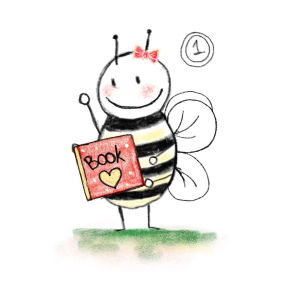
Step 1: Read a book!
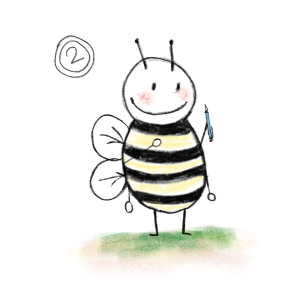
Step 2: Decide to Write a Review.
How often do you pick up a book without a recommendation or perusing reviews online? I still occasionally judge books by their cover at the local library but mostly I rely on recommendations from friends or via reviews online, and I bet you do too.
All of us readers love reviews!
Love a book, want to support an author? The best way is to write an honest review. Reviews are hugely important to us (largely because, like I mentioned, nobody picks up books without looking at reviews).
Love a book and want to support an illustrator? Ditto!
So, if you love readers, authors, illustrators or anyone else in the book industry, support them all and write a review!
Step 3: Don’t Panic!
Maybe you’ve never written a review before, maybe you don’t know where to start.
It’s okay…
View original post 447 more words
Terms You Need to Know Before Signing a Publishing Contract – by Melinda Clayton…

 on Indies Unlimited:

Here at Indies Unlimited we work hard to help you make good publishing decisions without getting scammed.
We talk about scammy publishers, scammy services, and scammy agents.
Some of us learned through the school of hard knocks, while others were cautious from the very beginning.
Still, not a month goes by that I don’t see someone make a decision that has me shaking my head.
Quite often, that decision has to do with contracts.
Continue reading HERE
How Does Amazon.com Sales Rank Work?

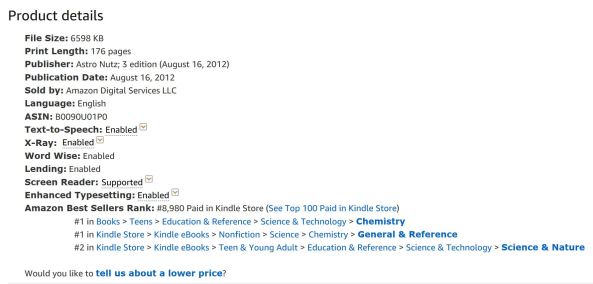
AMAZON.COM SALES RANK
Amazon assigns a sales rank to every product that has sold at least one time.
The lower the number, the better the product is selling.
For example, a sales rank of 2500 is better than a sales rank of 375,000.
The product that sells the best in its category has a sales rank of 1.
CATEGORY RANKS
Amazon has different ranks for different types of products.
Books are ranked independently from sports equipment and video games, for example.
For a given type of product, there are also category ranks.
For example, a few Books categories include Romance, Children’s, and Science.
A great overall rank is more impressive than a category rank.
For example, a book has to sell quite frequently to rank 500 overall in Books, but can sell much less frequently and still rank 500 in Romance.
A good rank in a broad category is more…
View original post 2,918 more words
How Change Can Be a Good Thing – In Life and In Writing

I’m moving.
This week has been spent packing, painting, and making seemingly endless to-do lists.
I’m partially moving to be closer to friends and family, partially to be closer to my new job (that I took partially BECAUSE of it’s proximity to the aforementioned friends and family), and partially because it’s cheaper there than it is where I am now.
That’s a lot of change.
I think it’s going to be a good thing.
Getting Away From The Status Quo
In life, if you don’t make changes, you end up doing the same thing, day-after-day, year-after-year. If you want to reach your dreams, you need to be actively working towards them, changing your life to get you there. Wishes are only useful for the direction they give you.
 Enter a caption
In writing, if you don’t read and practice and learn how to use criticism to grow, your writing won’t…
View original post 292 more words


