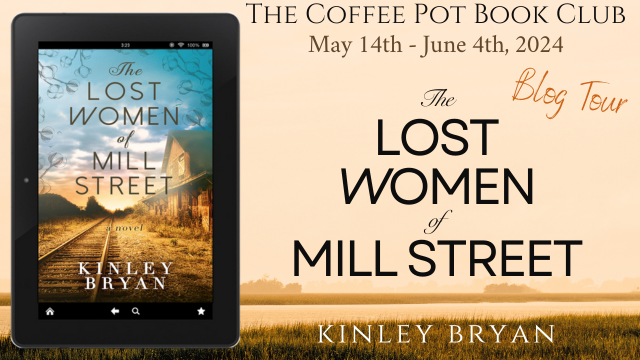
Media Kit
Book Title: The Lost Women of Mill Street
Series: n/a
Author: Kinley Bryan
Publication Date: May 7, 2024
Publisher: Blue Mug Press
Page Count: 300
Genre: Historical Fiction
Twitter Handle: @kinleybauthor @cathiedunn
Instagram Handle: @kinleybryanauthor @thecoffeepotbookclub
Hashtags: #HistoricalFiction #WomenInHistory #AmericanCivilWar #BlogTour #TheCoffeePotBookClub
Tour Schedule Page: https://thecoffeepotbookclub.blogspot.com/2024/03/blog-tour-the-lost-women-of-mill-street-by-kinley-bryan.html
Book Title and Author Name:
The Lost Women of Mill Street
by Kinley Bryan
Blurb:
1864: As Sherman’s army marches toward Atlanta, a cotton mill commandeered by the Confederacy lies in its path. Inside the mill, Clara Douglas weaves cloth and watches over her sister Kitty, waiting for the day her fiancé returns from the West.
When Sherman’s troops destroy the mill, Clara’s plans to start a new life in Nebraska are threatened. Branded as traitors by the Federals, Clara, Kitty, and countless others are exiled to a desolate refugee prison hundreds of miles from home.
Cut off from all they’ve ever known, Clara clings to hope while grappling with doubts about her fiancé’s ambitions and the unsettling truths surrounding his absence. As the days pass, the sisters find themselves thrust onto the foreign streets of Cincinnati, a city teeming with uncertainty and hostility. She must summon reserves of courage, ingenuity, and strength she didn’t know she had if they are to survive in an unfamiliar, unwelcoming land.
Inspired by true events of the Civil War, The Lost Women of Mill Street is a vividly drawn novel about the bonds of sisterhood, the strength of women, and the repercussions of war on individual lives.
Kinley Bryan, author of The Lost Women of Mill Street

When Angels Fly
Guest Post for June 4, 2024
American milliners in the Civil War era
“Had a most turbulent morning seeing the washerwoman, dressmaker & milliner…” –Diary of Emily Marshall Elliot, June 9, 1864
My latest historical novel, The Lost Women of Mill Street, takes place during the final year of the American Civil War. While it is a wartime story, it is also a coming-of-age survival tale that takes place far from the battlefield.
In part of the story, the millinery profession plays an important role. While I knew little about 19th century American milliners when I began writing, I learned much from The Female Economy: The Millinery and Dressmaking Trades, 1860-1930 by Wendy Gamber.
Though portrayed in fiction of the time as genteel women, most milliners were from the working class.
Gamber writes that most late 19th century U.S. milliners “seem to have been upwardly mobile daughters of the working class.” Despite the portrayal of fictional milliners as formerly well-to-do women who have fallen on hard times—and who yearn to be rescued by marriage—this seems not to be the case. Gamber says that “actual tradeswomen distinguished themselves by their widespread rejection of [marriage].”
The typical 19th-century American milliner was an unmarried woman in her thirties or forties (also white and native born)
Gamber uses data from the city of Boston for this assessment. Whether these Boston milliners were enthusiastically single or reluctantly so, Gamber says, is difficult to know. While “single women were uniquely free from male control,” they were also “the most economically vulnerable, for they generally had access to less capital” than their married counterparts.
There was a hierarchy among workers in a millinery shop
On the lowest rung were the apprentices. After completing an apprenticeship (which could take anywhere from three months to two years), an employee would advance to the role of maker—one who creates the hat shapes. From there a maker could be promoted to trimmer. A more artistic role, the trimmer would adorn the hat shapes with ribbons, lace, flowers, and other trimmings. While some high-end shops also employed designers to create the designs that trimmers would follow, most often it was the trimmer who did both the designing and trimming work.
Custom millinery disappeared over time with the growing popularity of ready-to-wear styles
Men’s hats were more easily mass produced, and some manufacturers were doing so as early as the 1840s. But women’s hats, especially the elaborate styles of the late 19th century, were less well-suited to mass production. Customers of that era expected diversity; they did not want the same hat that was worn by hundreds of others.
This began to change by the early 20th century, when increasing numbers of women were buying ready-to-wear hats sold at a retailer, rather than custom hats made by a milliner in a shop. With the help of mechanical inventions, economies of scale, and division of labor, manufacturers were able to produce hats more cheaply than a tradeswoman could. Gamber says that by the early 1900s, the “ready-to-wear hat was cheap; the average consumer, finding prices at an all-time low, was more than willing to sacrifice quality for quantity.”
Buy Link:
Universal Buy Link: https://books2read.com/lostwomenofmillstreet

Author Bio:
Kinley Bryan’s debut novel, Sisters of the Sweetwater Fury, inspired by the Great Lakes Storm of 1913 and her own family history, won the 2022 Publishers Weekly Selfies Award for adult fiction. An Ohio native, she lives in South Carolina with her husband and three children. The Lost Women of Mill Street is her second novel.
Author Links:
Website: https://kinleybryan.com/
Twitter: https://twitter.com/kinleybauthor
Facebook: https://www.facebook.com/KinleyBryanWrites
Instagram: https://www.instagram.com/kinleybryanauthor/
Book Bub: https://www.bookbub.com/profile/kinley-bryan
Amazon Author Page: https://www.amazon.com/stores/Kinley-Bryan/author/B09J5GWDLX
Goodreads: https://www.goodreads.com/author/show/21892910.Kinley_Bryan
 When Angels Fly
Thank you so much for hosting Kinley Bryan today, Mary. Very kind of you.
Take care,
Cathie xo
The Coffee Pot Book Club
LikeLiked by 1 person
Welcome, Cathie
LikeLike