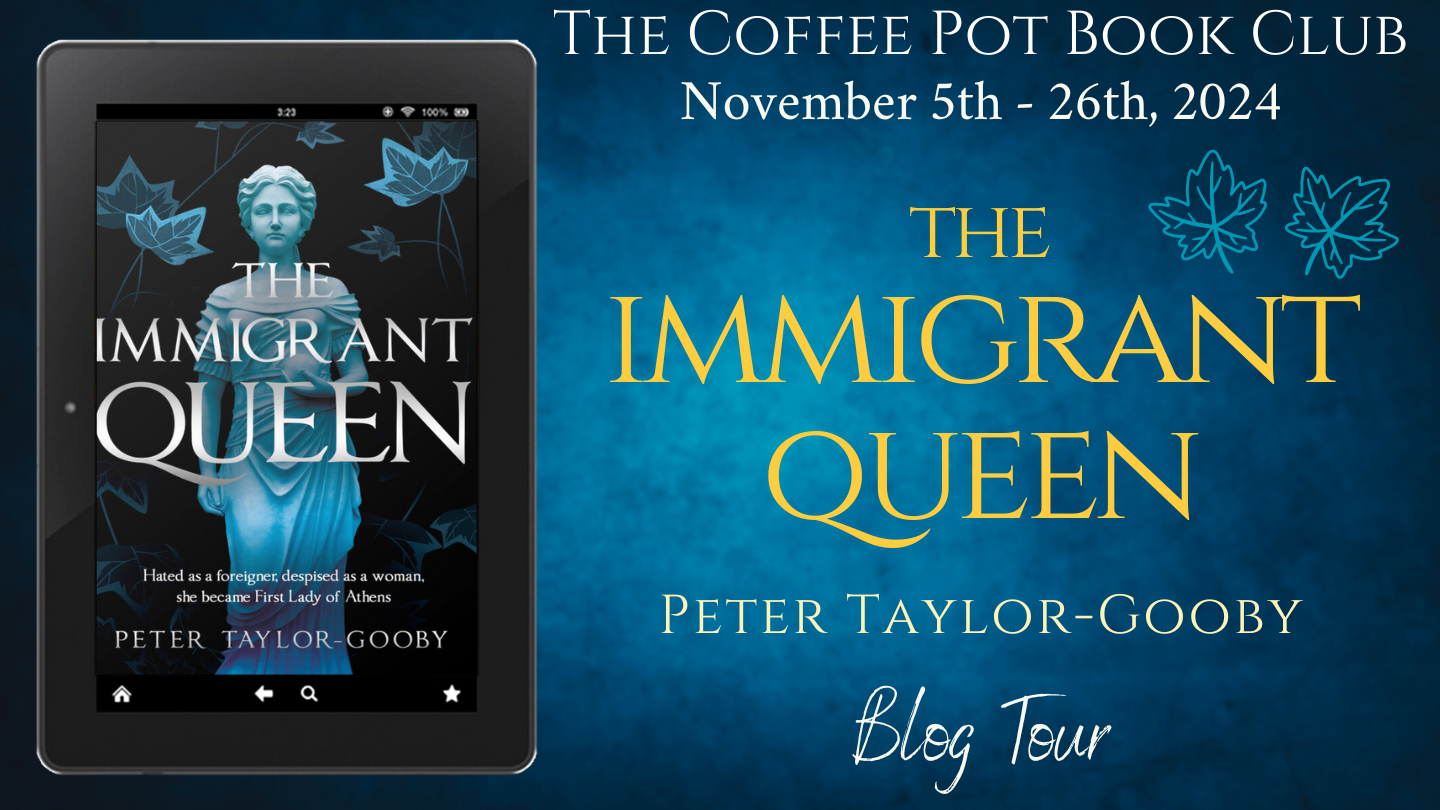
Book Title: The Immigrant Queen
Author: Peter Taylor-Gooby
Publication Date: 28th October 2024
Publisher: Troubador
Pages: 312
Genre: Historical Fiction
Twitter Handle: @cathiedunn @MaryLSchmidt
Instagram Handle: @thecoffeepotbookclub
Hashtags: #HistoricalFiction #AncientGreece #BlogTour #TheCoffeePotBookClub
Tour Schedule Page: https://thecoffeepotbookclub.blogspot.com/2024/10/blog-tour-the-immigrant-queen-by-peter-taylor-gooby.html
Book Title and Author Name:
The Immigrant Queen
Peter Taylor-Gooby
Blurb:
Hated as a foreigner, despised as a woman, she became First Lady of Athens.
Aspasia falls passionately in love with Pericles, the leading statesman of Fifth Century Athens. Artists, writers and thinkers flock to her salon. She hides her past as a sex-worker, trafficked to the city, and becomes Pericles’ lover.
Her writings attract the attention of Socrates, and she becomes the only woman to join his circle. She is known throughout the city for her beauty and wit and strives to become recognised as an intellectual alongside men.
Pericles’ enemies attack him through Aspasia and charge her with blasphemy. As a foreigner she faces execution, but her impassioned address to the jury shames the city and saves her. Pericles is spellbound, they marry, and she becomes First Lady of Athens.
Sparta besieges the city; plague breaks out and Pericles is once again in danger.
THE IMMIGRANT QUEEN tells the true story of how Aspasia rose to become the First Lady of Athens and triumphed against all the odds.
Guest Blog for When Angels Fly
Aspasia’s World – the background of Fifth Century Athens
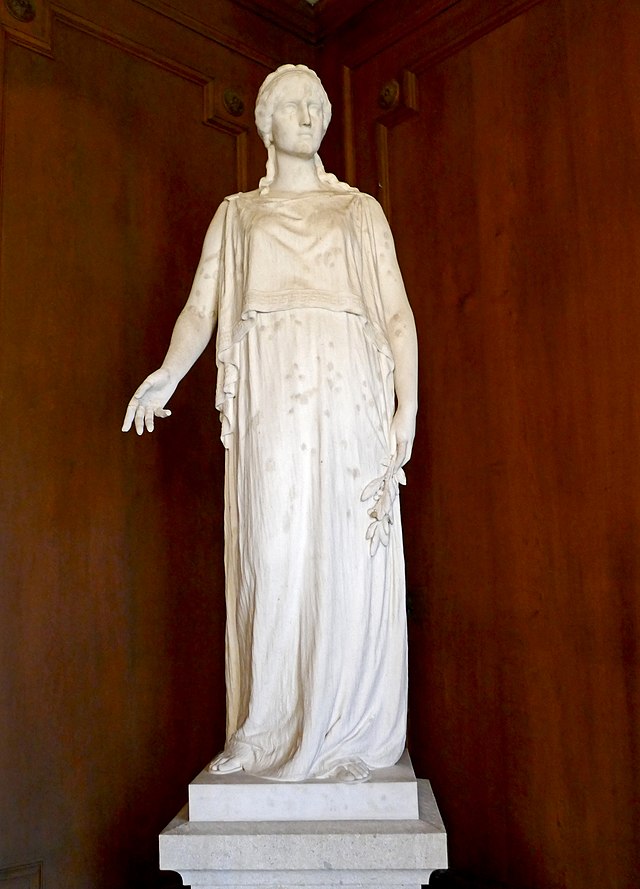
Aspasia was a remarkable figure of great intellectual and political insight who made her way in Athens, the leading city in the Eastern Mediterranean at the height of its glory. The background of the city shaped her life and the opportunities open to her, as a woman, as a non-citizen and as someone who wished to make her mark on history and succeeded.
A modern observer would be struck by the similarities and differences between Athens “the cradle of Western civilisation” and contemporary societies. Both have highly developed cultures and think of themselves as democratic. Both are markedly unequal, on both gender and class lines, and are marred by racism and tensions over immigration. In both, political life is increasingly influenced by populism. Both are prepared to engage in destructive wars for their own advantage and to justify the slaughter of enemies as advancing humane values.
At this time Athens was the acknowledged leader of the Greek world in drama, architecture, philosophy, sculpture, literature and public education. The plays performed at the Dionysiac festival in the city still provide a fertile basis for much modern drama. Athenian philosophy is still at the heart of our thinking. Aspasia was the only woman ever to be included in Socrates circle and her dialogues are quoted with respect by contemporary thinkers such as Xenophon. She was a woman, so her work was of low priority for copyists in the great libraries and is now almost all lost.
The city was also a direct democracy in which officers (apart from generals) were chosen by lot and ordinary citizens were required to participate in meetings and paid to do so.
The Athenians ruled a great Empire stretching beyond the Eastern Mediterranean and brutally repressed any attempts to withhold tribute or secede. The city used the taxes it levied to build temples pre-eminently Parthenon, and public buildings and for armaments, ships and fortifications. A major additional source of income was the silver mine at Laurion where slaves laboured underground naked and in chains throughout their short lives. The historian Diodorus Sicilius regarded conditions there as atrocious even by contemporary standards.
Athens was a divided society. Women had virtually no rights and, in families that could afford it, were rarely seen in public. While men, especially from the upper class, were highly educated most women would receive only very basic schooling. Aspasia contributed to women’s education, opening an academy for women parallel to those provided for men. We can only imagine the discussions that would have taken place, and their impact on the women fortunate enough to participate.
The rights to vote and hold public office were confined to male citizens, a small minority, who met in the Assembly, the key decision-making body. Generals were directly accountable to their fellow-citizens and on a number of occasions were executed for displeasing them. Pericles’ power was based on the growth of a wider democracy, with the loose coalition of ordinary citizens, centred on the harbour, Piraeus becoming more assertive against the old aristocrats.
In the sixth century Athens had made a difficult transition from a kingdom to an aristocracy and then a city in which more and more people exerted influence. These shifts were driven by the importance of agriculture which gave power to large landowners running slave-farms, and then as commerce developed to an expanding middle-class. The shift from the land army based on the aristocrat warriors to the fleet, supreme in the Greek world, also enhanced the influence of the ship-builders and workers on the coast and the citizens who rowed the triremes. At the height there were nearly two hundred docks on the coast each providing at least one trireme a year.
Estimates of the size of the different population groups vary. At the zenith of its power, the city contained between two hundred and fifty and three hundred and seventy thousand people. A small number came from aristocratic families with many slaves and substantial hereditary land-holdings who wielded disproportionate power. About a fifth were Athenians (citizens if they were male) by virtue of descent from the original inhabitants of the land, a bit under a third ‘outlanders’ (immigrants attracted by the wealth of the city, who had very few rights) and slightly under half slaves with no rights whatsoever. The conditions under which slaves lived varied: a minority were valued for their skills as musicians, craftsmen or secretaries. Most worked on farms or in the mines and were treated and thought of as little better than animals, since contemporary thinkers believed that they lacked a soul and an advanced capacity to reason. Household slaves came somewhere in between.
Aspasia’s life was touched by the thirst for glory. Various writers tell of the oracle that accompanied the birth of Achilles, “the greatest of the Greeks” as Homer calls him. Achilles must choose: fight on the plains of Troy and die young but gain a lasting fame, or live long and comfortably, sitting by the fireside in a forgotten kingdom and fade from men’s memories. He chose to fight and die. Men will read of his deeds as long as the Iliad exists.
Later, Odysseus met Achilles in the underworld and asked him whether he still thought he had made the right choice. He replied:
“Say not a word in death’s favour. I would rather be a beggar in a poor man’s house and be above ground, than king of kings among the dead.”
Aspasia also yearned for glory and lived a strenuous and in some ways painful life in a brutal yet highly civilised city. We still remember her name. Pericles died of the plague in the second year of the thirty year war between Athens and Sparta. Finally the city surrendered and fell from eminence. Whether she regretted her quest for glory is unclear. She was certainly a woman of great achievement who faced many challenges and overcame them. I have always thought that her story should be told. This is my attempt to do so.
Probably the best source for Aspasia’s life and the political background is Prisoner of History: Aspasia of Miletus and Her Biographical Tradition by Madeleine M. Henry, Oxford University Press, 1995. This provides a full review of the literature on Aspasia.
Paperback Buy Links:
https://www.waterstones.com/book/the-immigrant-queen/peter-taylor-gooby/9781836280606
https://troubador.co.uk/bookshop/historical/the-immigrant-queen

Author Bio:
Peter Taylor-Gooby is an academic who believes that you can only truly understand the issues that matter through your feelings, your imagination and your compassion. That’s why he writes novels as well as research monographs. He worked in India as a teacher, in a Newcastle social security office and as an antique dealer.
Now he’s professor of social policy at the University of Kent, a Fellow of the British Academy, loves playing with his grandchildren and writes novels in what time is spare.
Author Links:
Facebook: https://www.facebook.com/peter.taylorgooby/
Troubadour Author Page: https://troubador.co.uk/author/glndwnle
Wikipedia: https://en.wikipedia.org/wiki/Peter_Taylor-Gooby
Amazon Author Page: https://www.amazon.co.uk/stores/author/B001HD2YWQ
 When Angels Fly
Thank you for hosting Peter Taylor-Gooby today, with such an interesting post.
Take care,
Cathie xo
The Coffee Pot Book Club
LikeLiked by 1 person
Welcome, Cathie.
LikeLike