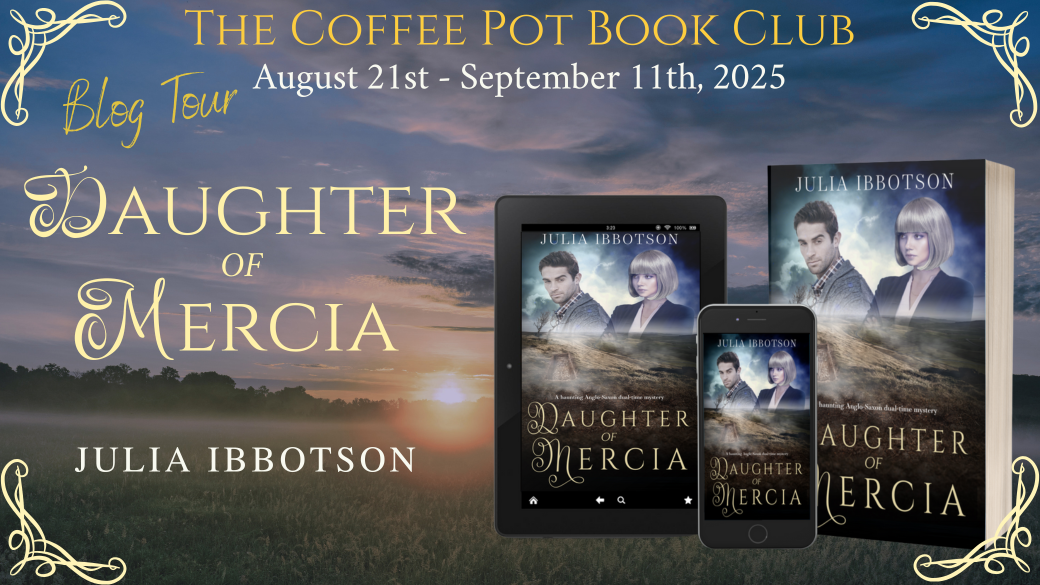
Name: Julia Ibbotson
Book Title: Daughter of Mercia
Series: Dr Anna Petersen Mysteries, book #1
Publication Date: June 6th, 2025
Publisher: Archbury Books
Pages: 301 ebk, 392 pbk
Genre: medieval dual-time mystery romance
Any Triggers: n/a
Twitter Handles: @JuliaIbbotson @cathiedunn @marylschmidt
Instagram Handles: @julia.ibbotson @thecoffeepotbookclub
Hashtags: #DaughterOfMercia #JuliaIbbotson #medieval #anglosaxon #dualtime #timeslip #timetravel #mystery #romance #BlogTour #TheCoffeePotBookClub
Tour Schedule Page: https://thecoffeepotbookclub.blogspot.com/2025/08/blog-tour-daughter-of-mercia-by-julia-ibbotson.html
Book Title and Author Name:
Daughter of Mercia
by Julia Ibbotson
Blurb:
Echoes of the past resonate across the centuries as Dr Anna Petersen, a medievalist and runologist, is struggling with past trauma and allowing herself to trust again. When archaeologist (and Anna’s old adversary) Professor Matt Beacham unearths a 6th century seax with a mysterious runic inscription, and reluctantly approaches Anna for help, a chain of events brings the past firmly back into her present. And why does the burial site also contain two sets of bones, one 6th century and the other modern?
As the past and present intermingle alarmingly, Anna and Matt need to work together to solve the mystery of the seax runes and the seemingly impossible burial, and to discover the truth about the past. Tensions rise and sparks fly between Anna and Matt. But how is 6th century Lady Mildryth of Mercia connected to Anna? Can they both be the Daughter of Mercia?
For fans of Barbara Erskine, Elena Collins, Pamela Hartshorne, Susanna Kearsley and Christina Courtenay.
When Angels Fly (Coffee Pot Book Tour, August 2025)
Guest post of my choice: Researching for a dual time/timeslip novel set in Anglo-Saxon times.
My latest novel, Daughter of Mercia (#1 Dr Anna Petersen series of haunting early medieval dual time / timeslip mystery romances) is really about two stories that mirror and intertwine: Dr Anna in the present and Lady Mildryth in 535 AD, both with a mystery to solve. I love researching the Anglo-Saxon world, since I studied it at university for my first degree. I revisited my research for my previous series of Anglo-Saxon dual time/timeslips, the Dr DuLac series, as there have been many interesting archaeological findings more recently. So I could update my work in line with new evidence, much arising from digs along the ill-fated HS2 line.
I write mainly about domestic history, rather than battles, kings and queens, so I love finding out about evidence related to how people used to live in those times: how did people dress in the 6th century? What did they eat? What were their houses like? How did they live? One of the best things about writing novels set in a particular historical period is the research. OK, a novel is fiction and I have taken some liberties, but readers still want to see it as an authority.
When I read a novel myself, I want enjoy the story but also to feel I’m learning something correct and authentic. It’s exciting to see that archaeology is now finding many clues as to everyday domestic life in the 5th /6th /7th centuries AD. Of course, Lady Mildryth is a high-status lady, a powerful regional cūning, (settlement leader) so her everyday life would have been somewhat richer than the lower classes of ceorls (freed men), or even of many lower thegns (high warriors). This is reflected in the archaeology of grave goods in high status burials.
It’s interesting to discover that life was much richer and more ‘advanced’ than had previously been supposed. There is now a growing body of archaeological, osteo-archaeological, geophysical and isotopic evidence to indicate how the people of the 5th, 6th and 7th centuries lived: feasting halls, jewellery, imported luxury goods. Recent excavations have uncovered evidence of large feasting halls (mead halls) as a focal point of the settlements, and analyses of human bones found in the cemeteries attached to these villages have confirmed the diet of meat, fish (for the wealthy), bread loaves, fresh vegetables and fruit, and, more surprisingly imported dates, figs, almonds, wine, although only for the wealthy.
In Cambridge, 2020, at the Kings College site, another 5th -6th century cemetery revealed rich jewellery including a chest brooch bearing fragments of cloak fabric showing evidence of a sophisticated weave, possibly indicating Byzantine trade, or local craftsmanship learned from elsewhere. On Salisbury Plain a 7th century burial revealed silver coin, bronze and silver rings, amethyst beads. Gold rings, jewel-encrusted brooches, bracteates (neck pendants) and gold torcs (neck rings), as well as engraved and jewelled seaxes, have also been excavated.
So, the Anglo-Saxon and early medieval periods are proving to be every bit as rich, culturally diverse and interesting in terms of everyday domestic life as later periods. It clearly wasn’t all about battles and land-grab!
However, to some extent, I also had to use my deductive powers to assess what might have been retained from the earlier Roman period, and what might be developing forward into the Anglo-Saxon period So there was a fair amount of both evidence and informed imagination at work as I wrote Daughter of Mercia.
It’s the same if you’re writing about a particular concept – as in the idea of time-slip, or echoes of a previous time period, and whether it could actually happen – and as an author, making the story believable. Could it possibly happen? And how? For Daughter of Mercia, I have a complex plot involving both Lady Mildryth and Dr Anna Petersen experiencing visions of being in a different time as Anna tries to resolve a mystery arising from strange findings at an archaeological dig, so I needed to research concepts of time, as well as archaeology.
I looked again at the scientific theories of quantum mechanics, which sounds a bit like something from Dr Who: the Einstein-Rosen Bridge theory, and worm-holes. Yes, really! They’re all basically scientific ideas about space-time portals through which you could ‘slip’, or glimpse, from one layer of the universe into another, or from one historic period into another. Fascinating, especially for all those who like fantasy and the paranormal, and yet these are real scientific theories of the concept of time, albeit unlikely to be tested by experiment! Strangely enough, I seem to be hearing those theories quoted so much more these days in the media, for example the lovely Professor Brian Cox in his fascinating series on the birth of the universe. So maybe something out there is catching on!
Timeslip sounds insane, and of course Anna wonders what on earth is going on in her mind, yet as her life intertwines with Lady Mildryth’s, she comes to realise another important reason for her ability to identify with her counterpart in Anglo-Saxon times: a shared family history and a shared traumatic experience.
If you want to read more about this period of history, I have a series (Living with the Anglo Saxons) on my blog at https://juliaibbotsonauthor.com
Buy Link:
Universal Buy Link: https://myBook.to/DOMercia
This title is available to read on #KindleUnlimited.
Author Bio:
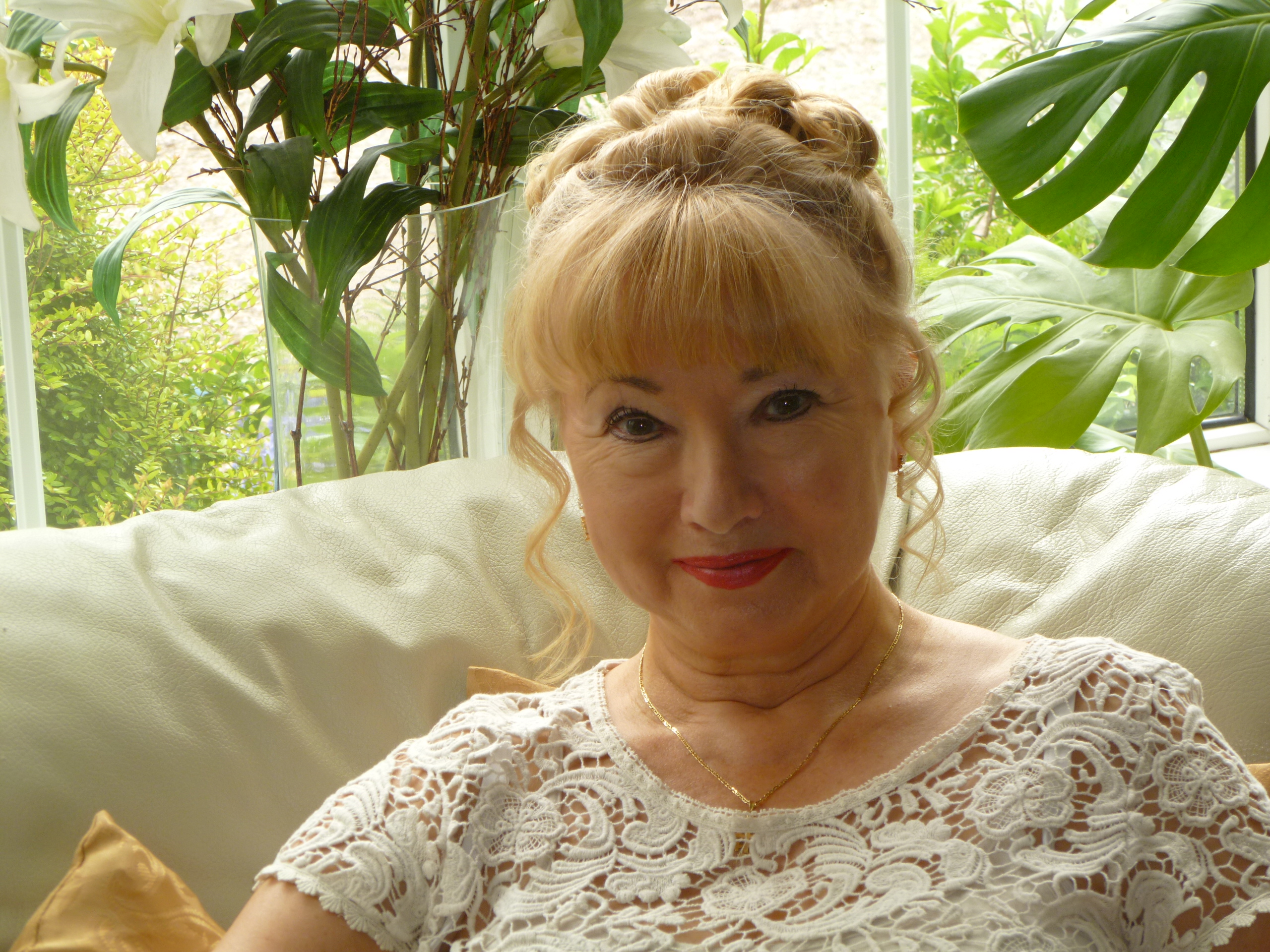
Julia Ibbotson is fascinated by the medieval world and the concept of time. She is the author of historical mysteries with a frisson of romance. Her books are evocative of time and place, well-researched and uplifting page-turners. Her current series focuses on early medieval time-slip/dual-time mysteries.
Julia read English at Keele University, England, specialising in medieval language / literature / history, and has a PhD in socio-linguistics. After a turbulent time in Ghana, West Africa, she became a school teacher, then a university academic and researcher. Her break as an author came soon after she joined the RNA’s New Writers’ Scheme in 2015, with a three-book deal from Lume Books for a trilogy (Drumbeats) set in Ghana in the 1960s.
She has published five other books, including A Shape on the Air, an Anglo-Saxon timeslip mystery, and its two sequels The Dragon Tree and The Rune Stone. Her latest novel is the first of a new series of Anglo-Saxon dual-time mysteries, Daughter of Mercia, where echoes of the past resonate across the centuries.
Her books will appeal to fans of Barbara Erskine, Pamela Hartshorne, Susanna Kearsley, and Christina Courtenay. Her readers say: ‘Julia’s books captured my imagination’, ‘beautiful story-telling’, ‘evocative and well-paced storylines’, ‘brilliant and fascinating’ and ‘I just couldn’t put it down’.
Author Links:
Website: https://juliaibbotsonauthor.com
Twitter / X: https://twitter.com/@juliaibbotson
Facebook: https://www.facebook.com/JuliaIbbotsonauthor
Instagram: https://www.instagram.com/julia.ibbotson
Bluesky: https://bsky.app/profile/juliaibbotson.bsky.social
Pinterest: https://www.pinterest.co.uk/juliai1
Amazon Author Page: https://Author.to/JuliaIbbotsonauthor
Goodreads: https://goodreads.com/juliaibbotson
 When Angels Fly
Thank you so much for hosting Julia Ibbotson today, with such a fascinating post about her research for her evocative new novel, Daughter of Mercia.
Take care,
Cathie xo
The Coffee Pot Book Club
LikeLiked by 2 people
Welcome, Cathie!
LikeLike
Thank you so much for featuring my book today with my guest post too! Much appreciated.
LikeLiked by 1 person
Welcome!
LikeLike