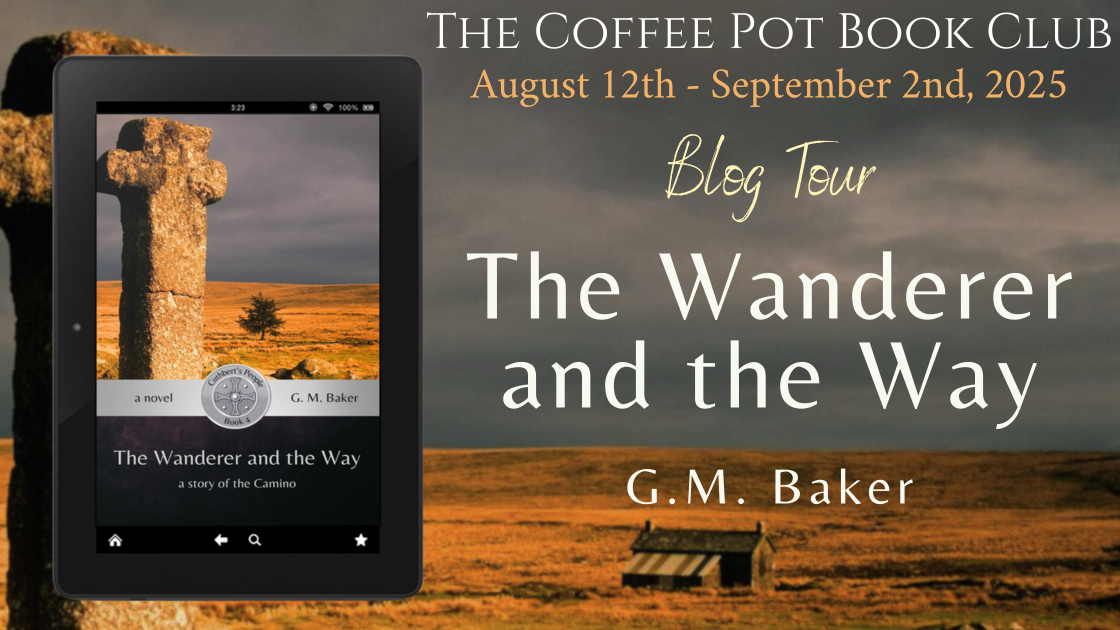
Book Title: The Wanderer and the Way
Series: Cuthbert’s People
Author Name: G. M. Baker
Publication Date: March 10th, 2025
Publisher: Stories All the Way Down
Pages: 249
Genre: Historical Fiction
Any Triggers: Rape is mentioned by not portrayed.
Twitter Handle: @mbakeranalecta @cathiedunn @marylschmidt
Instagram Handle: @thecoffeepotbookclub
Hashtags: #HistoricalFiction #MedievalFiction #SantiagoDeCompostela #BlogTour #TheCoffeePotBookClub
Tour Schedule Page: https://thecoffeepotbookclub.blogspot.com/2025/07/blog-tour-the-wanderer-and-the-way-by-g-m-baker.html
Book Title and Author Name:
The Wanderer and the Way (Cuthbert’s People, Book 4)
by G. M. Baker
Blurb:
The Camino de Santiago de Compostela, now the most famous pilgrimage route in the world,
was founded in the early ninth century, largely due to the efforts of Bishop Theodemir of Iria
Flavia. As with most people of this period, nothing seems to be known of his early years.
What follows, therefore, is pure invention.
Theodemir returns footsore and disillusioned to his uncle’s villa in Iria Flavia, where he meets Agnes, his uncle’s gatekeeper, a woman of extraordinary beauty. He falls immediately in love. But Agnes has a fierce, though absent, husband; a secret past; another name, Elswyth; and a broken heart.
Witteric, Theodemir’s cruel and lascivious uncle, has his own plans for Agnes. When the king of Asturias asks Theodemir to undertake an embassy on his behalf to Charles, King of the Franks, the future Charlemagne, Theodemir plans to take Agnes with him to keep her out of Witteric’s clutches.
But though Agnes understands her danger as well as anyone, she refuses to go. And Theodemir dares not leave without her.
Buy Link:
Universal Buy Link: https://books2read.com/thewandererandtheway
Guest Post for When Angels Fly
I’ve long been fascinated by journeying. I don’t mean travel in the modern sense, which is not about the journey but the destination. For the modern traveller, the airport serves as a kind of transporter device. You enter a box at your start, time passes, and you exit the box at your destination. You have travelled, but you have not journeyed.
Journeying is not entirely dead, of course. YouTube is full of videos of hikes and road trips and long-distance train rides. In all of these, the journey is part of the experience. In some cases it is secondary to the sites visited along the way. In some cases it is the main attraction. But journeying of this kind is very much a choice today, a form of recreation. Often people will use planes to teleport themselves to the starting point of their road trip, rail journey, or cruise.
I am a road-tripper myself, and I recently published a book of reflections and recollections of what my wife and I called our Grand Tour, beginning with Route 66, then north along the Pacific Coast Highway, then returning East via Yellowstone and the Badlands of South Dakota. The book is called Ordinary Eccentricity, and it is very much a book about journeying, the motivation for it, and the way it changes how you see the world and feel about life.
In the past, journeying was a necessary part of human life. It was arduous, expensive, and above all dangerous. And yet even when it was so difficult, people still took journeys voluntarily as well as out of necessity. Sometimes they took them as a means of doing penance for their sins. Thus we find in many cultures the practice of pilgrimage, the journey to a sacred place undertaken for the sake of the soul. Some pilgrimage routes are now world-famous and attract hikers and tourists as well as pilgrims. One such is the Camino de Santiago, the most famous pilgrimage route in the world, running from Saint-Jean-Pied-de-Port in southern France to Santiago de Compostela in northern Spain. My novel, The Wanderer and the Way, is an imaginary account of the youth of the man, Theodemir of Iria Flavia, who in later life was responsible for the founding of the Camino.
So many of my favorite books are about journeys. The Odyssey is the story of a journey. So are The Lord of the Rings, The Grapes of Wrath, Lonesome Dove, and Huckleberry Finn. There is nothing so sure as an arduous journey to expose the heart, the character, the longing, and the dread of every character. Even the prospect of such a journey can become a moment of crisis for a character, forcing them to make hard choices between competing values. The classic model of story is the Hero’s Journey, first described by Joseph Campbell and popularized by Christopher Vogler and Star Wars, includes a vital step (though one that is curiously missing from some popular versions), the refusal of the call to adventure. The call to adventure is the event that gives the hero a reason to go on the journey. But the drama in the call to adventure lies in the hero’s reasons not to go. The tension between the reasons to go and the reasons not to go shapes everything that will happen to the hero, all the decisions they will make, all the emotions they will have, throughout the whole journey. The hero lives and moves in the tension between the call to go forward and the call to hurry back. Without that tension, the story of the journey is a mere travelogue.
As the journey goes on, the hero will also be tempted to stop and stay at several points along the journey. These temptations renew and build upon the tension that drives the hero ever forward and calls him ever back. But this is not to ignore that sometimes what calls the hero onward is the road itself. The road can become the normal world of the hero, the world they understand and are accepted in. The call to settle down then becomes a call to a different kind of adventure. In Campbell’s account of the hero’s journey model, there is a second refusal, though Vogler did not include it in his model. This is the refusal of return. The hero has become so attuned to life on the road that he has become too wild to settle, and must contend with the same stay or go dilemma again, but in reverse.
One of the great attractions of the past as a setting for stories is that one does not have to do any work to make a journey arduous. Finding a way to present a modern character with the choice to go on an arduous journey or not is difficult because few journeys today are arduous, and one therefore needs to invent extraordinary circumstances or extraordinary motivations to plausibly present your character with that choice. But in the past, all journeys were arduous, to one degree or another, leaving the author free to concentrate on the essential dilemma of whether to go or to stay.
It is that dilemma that hangs over both my main characters in The Wanderer and the Way. For Agnes, the kidnapped wife of a Viking warrior, escaping from her husband, and from the lascivious local lord who employs him, means abandoning the women she was kidnapped with. For Theodemir, nephew of that same local lord, staying means becoming a monster in the mold of his uncle, and going means leaving Agnes to her fate. But go they do, as go they must, along the lonely, sun-scorched roads of the abandoned territory of the Douro and through the treacherous ways of the Pyrenees, menaced by Moorish raids and by the wild, fierce tribes of the Pyrenees, treading the arduous way that so many pilgrims in centuries to come will follow after them.

Author Bio:
Born in England to a teamster’s son and a coal miner’s daughter, G. M. (Mark) Baker now lives in Nova Scotia with his wife, no dogs, no horses, and no chickens. He prefers driving to flying, desert vistas to pointy trees, and quiet towns to bustling cities.
As a reader and as a writer, he does not believe in confining himself to one genre. He writes about kind abbesses and melancholy kings, about elf maidens and ship wreckers and shy falconers, about great beauties and their plain sisters, about sinners and saints and ordinary eccentrics. In his newsletter Stories All the Way Down, he discusses history, literature, the nature of story, and how not to market a novel.
Author Links:
Website: https://gmbaker.net
Substack: https://gmbaker.substack.com/
Twitter / X: https://x.com/mbakeranalecta
Facebook: https://www.facebook.com/gmbaker
Book Bub: https://www.bookbub.com/profile/g-m-baker
Amazon Author Page: https://www.amazon.com/stores/G.-M.-Baker/author/B09WZK7MD4
Goodreads: https://www.goodreads.com/author/show/4259382.G_M_Baker
 When Angels Fly
Thank you so much for hosting G. M. Baker today, with such an interesting post linked to his intriguing novel, The Wanderer and the Way.
Take care,
Cathie xo
The Coffee Pot Book Club
LikeLiked by 1 person
Welcome, Cathie!
LikeLike