Media Kit
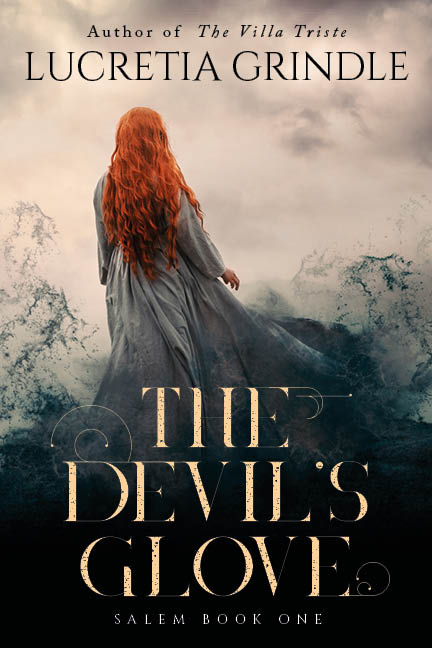
Book Title: The Devil’s Glove
Series: Salem
Author: Lucretia Grindle
Publication Date: May 1, 2023
Publisher: Casa Croce Press
Page Length: 346
Genre: Literary Historical Fiction
Twitter Handle: @cathiedunn
Instagram Handle: @bookwhispererink @thecoffeepotbookclub
Hashtags: #TheDevilsGlove #HistoricalFiction #Salem #BlogTour #TheCoffeePotBookClub
Blog Tour Page: https://thecoffeepotbookclub.blogspot.com/2023/04/blog-tour-the-devils-glove.html
Book Title and Author Name:
The Devil’s Glove
by Lucretia Grindle
Blurb:
Northern New England, summer, 1688.
Salem started here.
A suspicious death. A rumor of war. Whispers of witchcraft.
Perched on the brink of disaster, Resolve Hammond and her mother, Deliverance, struggle to survive in their isolated coastal village. They’re known as healers taught by the local tribes – and suspected of witchcraft by the local villagers.
Their precarious existence becomes even more chaotic when summoned to tend to a poisoned woman. As they uncover a web of dark secrets, rumors of war engulf the village, forcing the Hammonds to choose between loyalty to their native friends or the increasingly terrified settler community.
As Resolve is plagued by strange dreams, she questions everything she thought she knew – about her family, her closest friend, and even herself. If the truth comes to light, the repercussions will be felt far beyond the confines of this small settlement.
Based on meticulous research and inspired by the true story of the fear and suspicion that led to the Salem Witchcraft Trials, THE DEVIL’S GLOVE is a tale of betrayal, loyalty, and the power of secrets. Will Resolve be able to uncover the truth before the town tears itself apart, or will she become the next victim of the village’s dark and mysterious past?
Praise for The Devil’s Glove:
“From its opening lines this historical novel from Grindle (Villa Triste) grips with its rare blend of a powerfully evoked past, resonant characters, smart suspense, and prose touched with shivery poetry.”
~ BookLife Reviews Editor’s Pick
WHEN ANGEL’S FLY
Guest Post by Lucretia Grindle, author of The Devil’s Glove
In the brief time since The Devil’s Glove has been published, I have received more questions and comments about one character than about all of the others put together. Abigail Hobbs. I can’t say this surprises me. While the book is centered around Resolve Hammond and her mother, Deliverance, it revolves around Abigail. She is a primary catalyst and change figure, as well as being the uneasy combination of shadow and light most open to interpretation. Is she good? Is she bad? Is she evil? Supernatural? A Bad Cat? Or a child, struggling to survive in a perilous world? I don’t want to attempt to answer any of those questions or to analyse Abigail herself in this post – all of that is, of course, ultimately up to the reader. What I would like to do is discuss some aspects of the challenge, and satisfaction, of writing her as a character.
In many ways, Abigail Hobbs is the kind of gift historical novelists live for. Unlike the more famous Abigail (Williams) who was one of the main accusers, Abigail Hobbs was a fairly peripheral, if completely unique, figure in the drama-rama that became the Salem trials. She was barely fourteen when she was named by her peer group of mostly teen-aged girls, many of whom she had known for years, as one of the earliest accused witches.
This alone sets her apart. Mercy Lewis, a distant cousin, grew up with her. Susannah Sheldon almost certainly knew her. And they were sure she was a witch, or – something. So was pretty much everyone else she’d ever encountered, including her poor stepmother who, when questioned, stated plaintively that she would never have married into the Hobbs family if she had ‘known that she would have to cope with Such a One.’ Her father more or less said he was afraid of her, when he said anything at all. Abigail had that effect on people.
Oh yes, she said quite happily, when challenged by the po-faced Salem magistrates, she wandered alone in the woods. All the time. Mostly at night. She agreed, quite matter of factly, that she probably did fly. Then added that she was sorry if she inadvertently stuck pins in any one. She didn’t mean to. It was all, she explained without being asked, due the fact that four years earlier, she had ‘signed the black man’s book,’ one summer afternoon when they happened to meet up in the forest. After that, she’d promised to do everything he asked of her, so that probably explained the pins. When one of the magistrates finally recovered enough to speak, Abigail agreed that, yes, all things considered, she guessed she was a witch. It was unfortunate, she supposed, and she was sorry if it had caused any trouble, but what could she do? She had, after all, given the Black Man her word, and good girls kept their word, didn’t they? The startled magistrates then listened in silence as Abigail calmly elaborated on the details of witchdom, including the snack menu at demonic meetings, which was usually bread and cheese. Something she seemed to find a bit disappointing, considering.
Thanks to the 17th century mania for record keeping, and the extraordinary good luck that makes the Essex County Massachusetts archive one of the most complete and intact in the world, we have a fairly accurate record of who said, and occasionally did, what in Salem village and town in 1692. So we know that as Abigail spoke on that April afternoon, an uncharacteristic silence fell over the Salem village meeting house. The startled accusers couldn’t even bring themselves to fall on the floor or mutter about yellow birds, much less scream or point fingers. Their stunned silence might be interpreted as fear. Or admiration. Or possibly both. As for the magistrates, by the time Abigail Hobbs was finished they were equal parts bemused and horrified. Having no idea what else to do, they threw the entire family in jail. This was manna from heaven. And it got better.
As I looked into the history of the Hobbs family, it was hard not to come to the conclusion that they were simply unfortunate. Deciding to make their own way in the world, William and Avis Hobbs separated from their families in Watertown shortly after they were married and struck out for Topsfield, Massachusetts, where they acquired a small farm. At first they did well enough. Then, little by little, things began to fall apart. William never managed to get elected to town office. The farm survived but did not thrive. Avis had a son, then twins, then in 1678 a daughter, whom they called Abigail.
More mouths to feed did not make things better. By the mid-1680s, The Hobbs decided that they would be better off letting their farm to tenants and trying to make a new start in The Eastward. By the mid to late 17th century, Maine, then called The Eastward, had developed the sort of reputation that Alaska has today. It was where you went to start over; a hard, even perilous place but one where people were less likely to ask questions. Who you had been did not matter as much as it did in hide-bound Boston or increasingly cosmopolitan Salem. What you could do was mattered. Unfortunately, William Hobbs couldn’t do much for long, except drink.
Shortly after the Hobbs’ arrival in the settlement of Falmouth, which was about as far north as you could go at the time, the eldest son left to join the militia. Like most families, William, Avis and their children farmed a few acres on the outskirts, and lived close to the fort. They rented a house from the owner of The Ordinary, the village tavern where William, having failed yet again to make his mark in town politics, spent increasing amounts of time. Then, sometime in 1686, the twins drowned. No details of their deaths are recorded, but it is hard to avoid the sense that in some profound way, it broke the family. Or perhaps it just broke Avis’s heart. She died in the summer of 1688, leaving behind an absent son, a drunken husband and ten year old Abigail.
1688. Four years before Salem. The year Madockawando and the Abenaki Confederacy decided northern settlement had gone far enough. The year the militia came to Falmouth, attacked a fishing camp, took hostages, and sent them to Boston to be sold as slaves. The year London imploded and the Stuarts went into exile and half a world away King William’s war – a conflagration that would empty The Eastward – got started. The year Boston hung an Irish washerwoman for bewitching a group of children living in the house of a Divine called Cotton Mather. The year Abigail Hobbs said she went into the forest and signed the black man’s book.
The scaffolding of disaster that hovered around Abigail, combined with her own bizarre testimony, made her a character that was almost too good to be true. Not least because, apart from her dramatic bit part in the early days of the Salem Trials, not much is known about Her. We know about her family and about the circumstances that must have shaped her – but of the girl herself, little to nothing. In short, she was the sort of ‘gap’ in history, the kind of tantalizing glimpse and suggested shape, historical novelists dream of. Even better, at the time The Devil’s Glove takes place, in that long hot summer of 1688, she was a child.
Children are powerful precisely because they are in the process of coming into being. Their edges are not yet hardened, their moral codes not yet set. They are vessels for all the expectations, and delusions, all the wishful thinking of the adult world. Including innocence. I had long wanted to write all of that: the power, the evolution, the goodness, the badness, and mostly the knowingness that children carry within them. And I was fascinated by Abigail’s own assertions of what she thought had happened to her, and what she thought she was.
I don’t know how to answer a lot of the questions about Abigail Hobbs. In writing her, I tried to catch something of the power of her personality that one senses, still lingering in the archive that records that April day in Salem, 1692.
And this, to me, is the real beauty of historical fiction: the opportunity every once in a while, to glimpse in the historical record a vivid, almost vanishing figure. To have the chance to catch them by the hem, and – if not drag them back – invite them to stay a little and raise all the questions about who they are, and why, and how they did what they did. In short, to ask them to linger, and live a little while on the page. Not all of them agree. But Abigail did, and I am profoundly grateful.
Buy Links:
This title is available to read on #KindleUnlimited.
Universal Link: https://books2read.com/u/4EN58l
Amazon UK: https://www.amazon.co.uk/dp/B0BWSD5SVL/
Amazon US: https://www.amazon.com/dp/B0BWSD5SVL/
Amazon CA: https://www.amazon.ca/dp/B0BWSD5SVL/
Amazon AU: https://www.amazon.com.au/dp/B0BWSD5SVL/
Author Bio:
Lucretia Grindle grew up and went to school and university in England and the United States. After a brief career in journalism, she worked for The United States Equestrian Team organizing ‘kids and ponies,’ and for the Canadian Equestrian Team. For ten years, she produced and owned Three Day Event horses that competed at The World Games, The European Games and the Atlanta Olympics. In 1997, she packed a five mule train across 250 miles of what is now Grasslands National Park on the Saskatchewan/Montana border tracing the history of her mother’s family who descend from both the Sitting Bull Sioux and the first officers of the Canadian Mounties.
Returning to graduate school as a ‘mature student’, Lucretia completed an MA in Biography and Non-Fiction at The University of East Anglia where her work, FIREFLIES, won the Lorna Sage Prize. Specializing in the 19th century Canadian West, the Plains Tribes, and American Indigenous and Women’s History, she is currently finishing her PhD dissertation at The University of Maine.
Lucretia is the author of the psychological thrillers, THE NIGHTSPINNERS, shortlisted for the Steel Dagger Award, and THE FACES of ANGELS, one of BBC FrontRow’s six best books of the year, shortlisted for the Edgar Award. Her historical fiction includes, THE VILLA TRISTE, a novel of the Italian Partisans in World War II, a finalist for the Gold Dagger Award, and THE LOST DAUGHTER, a fictionalized account of the Aldo Moro kidnapping. She has been fortunate enough to be awarded fellowships at The Hedgebrook Foundation, The Hawthornden Foundation, The Hambidge Foundation, The American Academy in Paris, and to be the Writer in Residence at The Wallace Stegner Foundation. A television drama based on her research and journey across Grasslands is currently in development. THE DEVIL’S GLOVE and the concluding books of THE SALEM TRILOGY are drawn from her research at The University of Maine where Lucretia is grateful to have been a fellow at the Canadian American Foundation.
She and her husband, David Lutyens, live in Shropshire.
Social Media Links:
Website: http://LucretiaGrindle.com
Facebook: https://www.facebook.com/BookWhisperer.ink
LinkedIn: https://www.linkedin.com/company/bookwhisperer/
Instagram: https://www.instagram.com/bookwhispererink/
Amazon Author Page: https://www.amazon.com/author/lucretiagrindle
Goodreads: https://www.goodreads.com/author/show/827521.Lucretia_Grindle