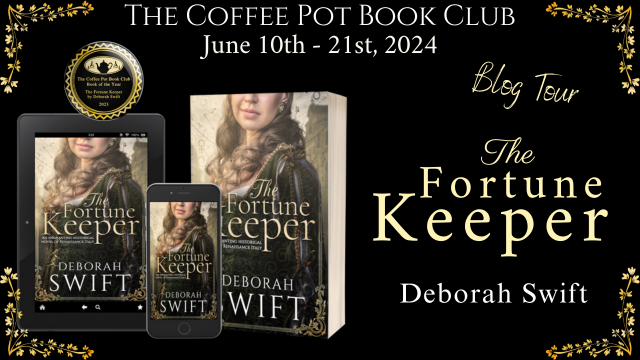
Book Title: The Fortune Keeper
Series: Italian Renaissance Series
Author: Deborah Swift
Publication Date: 24th November 2022
Publisher: Quire Books
Pages: 412
Genre: Historical Fiction
Twitter Handle: @swiftstory @cathiedunn
Instagram Handles: @coffeepotbookclub
Hashtags: #FortuneKeeper #HistoricalFiction #BlogTour #TheCoffeePotBookClub
Tour Schedule Page: https://thecoffeepotbookclub.blogspot.com/2024/05/blog-tour-the-fortune-keeper-by-deborah-swift.html
Book Title and Author Name:
The Fortune Keeper
by Deborah Swift
Blurb:
Count your nights by stars, not shadows ~ Italian Proverb
Winter in Renaissance Venice
Mia Caiozzi is determined to discover her destiny by studying the science of astronomy. But her stepmother Giulia forbids her to engage in this occupation, fearing it will lead her into danger. The ideas of Galileo are banned by the Inquisition, so Mia must study in secret.
Giulia’s real name is Giulia Tofana, renowned for her poison Aqua Tofana, and she is in hiding from the Duke de Verdi’s family who are intent on revenge for the death of their brother. Giulia insists Mia should live quietly out of public view. If not, it could threaten them all. But Mia doesn’t understand this, and rebels against Giulia, determined to go her own way.
When the two secret lives collide, it has far-reaching and fatal consequences that will change Mia’s life forever.
Set amongst opulent palazzos and shimmering canals, The Fortune Keeper is the third novel of adventure and romance based on the life and legend of Giulia Tofana, the famous poisoner.
‘Her characters are so real they linger in the mind long after the book is back on the shelf’
~ Historical Novel Society
NB This is the third in a series but can stand alone as it features a new protagonist. Other two books are available if reviewers want them.
Trigger Warnings:
Murder and violence in keeping with the era.

The FORTUNE KEEPER – POST FOR WHERE ANGELS FLY
5 interesting facts I discovered researching the Italian Renaissance Trilogy
by Deborah Swift
The Mafia existed even then
Italy was controlled by the mafia even in the 17th Century. They weren’t called the Mafia then though, they were called the Camorra. Capo = boss, Morra = a type of gambling game played in Naples. They were often controlled by family connection just as today, and ran drugs cartels, and a protection racket in which they threatened to beat up local shopkeepers unless they paid for protection.
Priests wandered about with no fixed abode
Because only one son could inherit most of the family fortune, the other sons were often made to be monks or clergy. Most churches had powerful families as their patrons who put pressure on the bishop to ordain their sons. Forced vocations were common, but as there were not enough churches to go round, so many men became wandering clergy. Their education was poor as there were few schools set up for training clergy, most of the dioceses lacked the resources to keep a seminary open. Sometimes these minor clerics got jobs as handymen, guards on lay estates, and some even joined groups of bandits!
Brotherhoods ran everything, even the schools
Confraternities were extremely powerful institutions in this era, the Neapolitan Confraternity of the Holy Spirit had 6000 members and supported a boarding school for 400 poor girls. It is believed that in the 17th Century, in any Italian town, a quarter of the adult male population were enrolled in a brotherhood of some sort. Although the supposed function of the confraternity was to raise its Catholic brothers into a better state of spiritual grace, these organizations were was widely used as a kind of ‘old boy’s network’ with corruption and cronyism at their heart.
An earthquake, volcanic eruption and tidal wave caused widespread deaths
When Mount Vesuvius erupted in 1631 it rained down lava and hot ash and buried many surrounding settlements. The seismic activity was preceded by an earthquake and followed by an immense tidal wave. Gigantic waves crashed onto the shore three times, destroying villages and many boats along the coastline. It is estimated this eruption was responsible for the deaths of approximately 4,000 people.
“… Not only ashes, but also stones falling down from the sky like fiery waste manufacturers who quarried from the forges, as big as a hand and even more … “ De Contreras, 1633.
Courtesans had aspirations to being classical goddesses
Prostitutes liked to change their names to suggest they were goddesses; Ortensio Lando in a letter says, ‘instead of Maria, Francesca, Ursula, Helena and Antonia, they call themselves Glyceria, Phryne, Thais, Flora, Lydia, Philena and Callidena.’ The classical names made them appear as if they had a knowledge of the classics, as well as bestowing the ideal of classical Greek beauty.
In truth courtesans lived well, and were often educated. They had to be, to attract the men that earned them their living. Some courtesans had regular clients, and would see them on regular days of the week – Pietro on Monday, Gianni on Tuesday, etc. etc. If a traveller from out of town wanted a night with her, he would have to pay not only the courtesan but also pay off her ‘regular.’
Thank you for hosting my guest post!
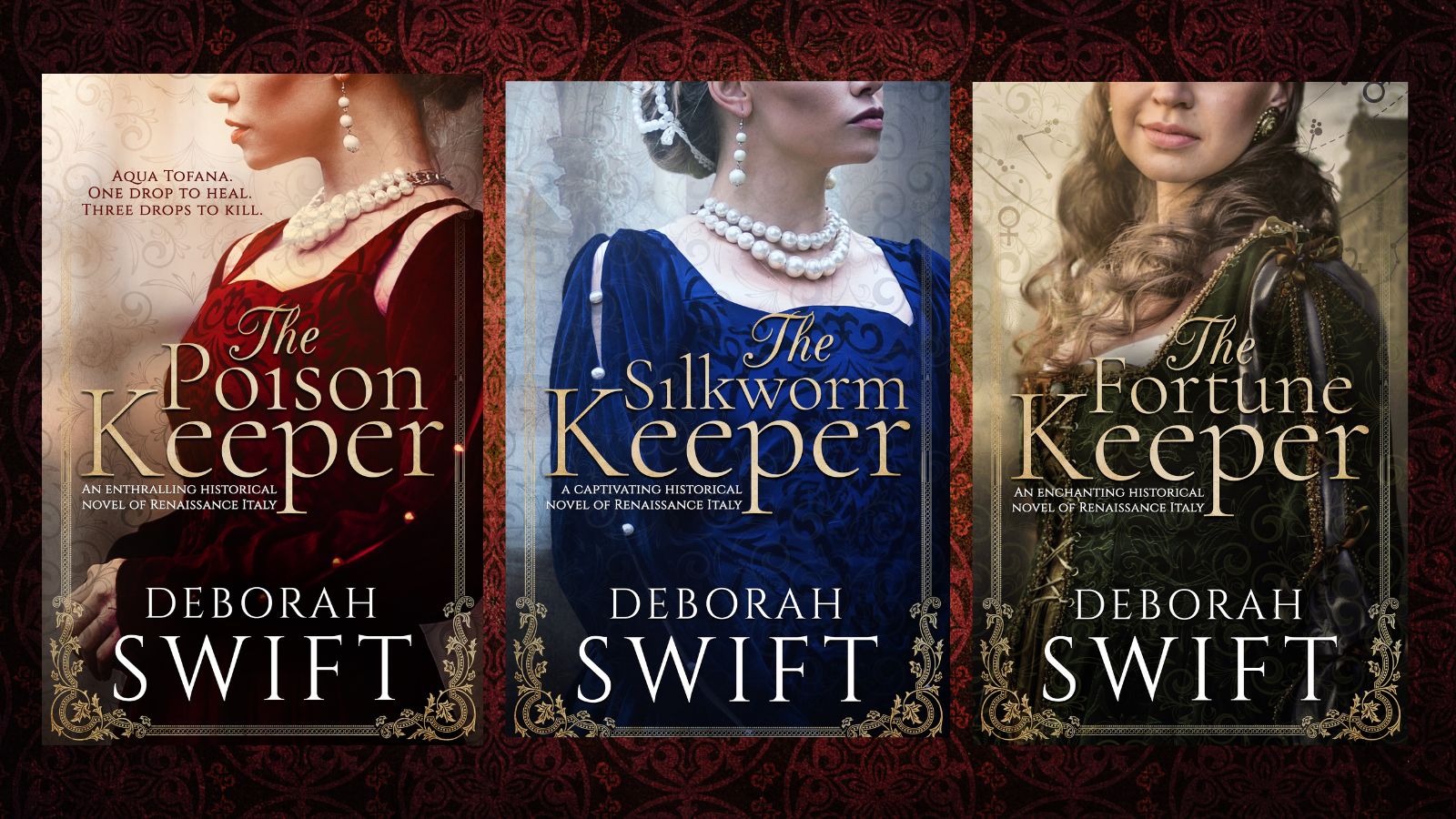
Find Deborah on Twitter @swiftstory or on her website www.deborahswift.com
BUY THE BOOK or read with KindleUnlimited subscription
Buy Links:
This title is available to read on #KindleUnlimited.
Universal Link: https://mybook.to/FortuneKeeper
Audiobook Buy Links:
Kobo: https://www.kobo.com/gb/en/audiobook/fortune-keeper-the
Audio: https://www.audible.co.uk/pd/The-Fortune-Keeper-Audiobook/B0C63R95WM
Author Bio:
Deborah Swift is a USA TODAY bestselling author who is passionate about the past. Deborah used to be a costume designer for the BBC, before becoming a writer. Now she lives in an old English school house in a village full of 17th Century houses, near the glorious Lake District. Deborah has an award-winning historical fiction blog at her website www.deborahswift.com.
Deborah loves to write about how extraordinary events in history have transformed the lives of ordinary people, and how the events of the past can live on in her books and still resonate today.
The first in her series about the Renaissance poisoner Giulia Tofana, The Poison Keeper, was a winner of the Wishing Shelf Book of the Decade, and a Coffee Pot Book Club Gold Medal, and the latest in her WW2 Secret Agent series, Operation Tulip, is coming soon.
Author Links:
Website: www.deborahswift.com
Twitter: https://twitter.com/swiftstory
Facebook: https://www.facebook.com/authordeborahswift/
Pinterest: https://www.pinterest.co.uk/deborahswift1/
Bookbub: https://www.bookbub.com/authors/deborah-swift
Amazon: http://author.to/DeborahSwift
 When Angels Fly
Thank you very much for hosting Deborah Swift today. I’m intrigued by those 5 interesting facts.
Take care,
Cathie xo
The Coffee Pot Book Club
LikeLiked by 1 person
Welcome Cathie
LikeLike